
GOP senator: President Trump should wear a mask

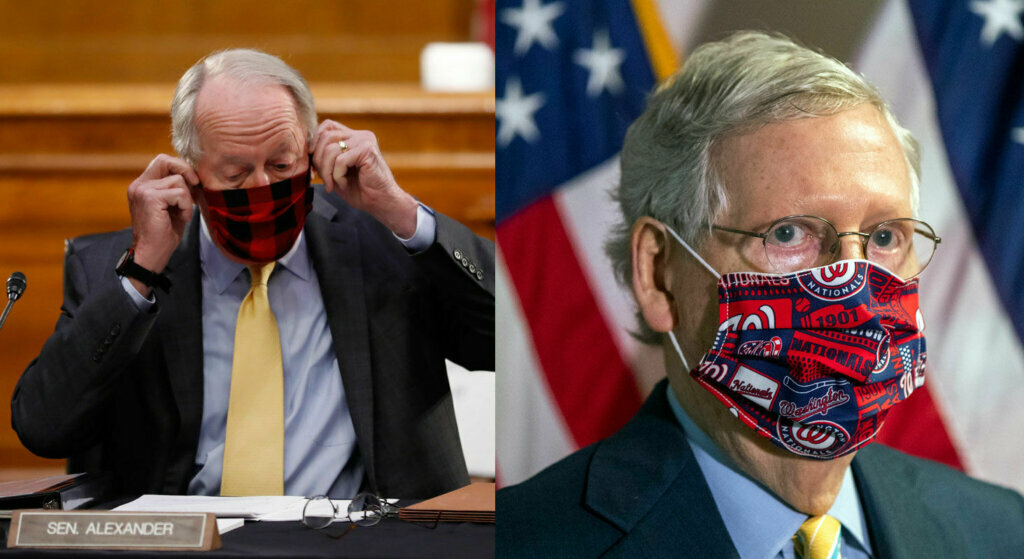
On left: Sen. Lamar Alexander, R-Tenn., wears a mask on Thursday, May 7, 2020. On right: Senate Majority Leader Mitch McConnell, R-Ky., wears a mask on Tuesday, June 30, 2020. (WTOP composite via AP Images)
Republican congressional leaders are becoming more vocal in the call to wear a face mask during the coronavirus pandemic, and a veteran GOP lawmaker is urging President Donald Trump to stop refusing to wear a mask in public. Sen. Lamar Alexander, R-Tenn., chair of the Senate Health, Education, Labor and Pensions Committee, directly addressed the issue ahead of testimony from Dr. Anthony Fauci and other members of the White House coronavirus task force. “The president has plenty of admirers. They would follow his lead (and) it would help end this political debate,” Alexander said Tuesday, referring to the split over whether to wear a mask. “The stakes are too high for this political debate about pro-Trump, anti-Trump masks continuing.” Alexander is close to Senate Majority Leader Mitch McConnell, who has been increasingly outspoken about the need to wear a mask. “Put on the mask. It’s not complicated,” McConnell said Tuesday as he spoke to reporters about legislation related to the coronavirus. McConnell also urged people to wear a mask while speaking on the Senate floor on Monday, noting there should be “no stigma” for people who put one on. Most members of both parties wear a mask in the halls of Congress and the U.S. Capitol. But as the number of coronavirus cases has increased in many states across the country, Republicans have become more assertive in their mask messaging and have broken with the president, who has declined to wear a mask. The House’s No. 3 Republican, Rep. Liz Cheney of Utah, recently tweeted a picture of her father and former Vice President Dick Cheney wearing a mask.

X

To view this content from @Liz_Cheney on X, click here.

Democratic lawmakers during hearings have at times admonished a handful of Republican lawmakers, who often don’t wear a mask, including Rep. Jim Jordan, R-Ohio, an ally of the president. Rep. Jim Clyburn, D-S.C., who chairs a select subcommittee on coronavirus oversight, has told members of the panel he will not call on them to speak if they don’t have a proper face covering. Alexander, speaking at the Senate hearing Tuesday, noted that lawmakers and others can personalize their masks like many Americans do. He noted he favors a plaid mask, which has roots in a red-and-black plaid shirt he wore when he walked across Tennessee and was elected governor decades ago. Alexander then referred to his hearing’s star witness, as well as Sen. Tim Kaine, D-Va., who often wears a bandanna as a face covering. “Dr. Fauci uses his mask to demonstrate his loyalty to the Washington Nationals,” Alexander said. “Sen. Kaine is either a cowboy or a bandit — I’m never sure which.”


More Coronavirus News

Looking for more information? D.C., Maryland and Virginia are each releasing more data every day. Visit their official sites here: Virginia | Maryland | D.C.
Analysis: The world Washington built is fraying. What comes next?

The United States is confronting a global security environment that increasingly resembles the outcome its Cold War adversaries once hoped to produce: a divided West, weakened alliances, economic exhaustion, multiple simultaneous wars and declining confidence in American leadership. That does not mean today’s crises were orchestrated according to some surviving Soviet master plan. The Soviet Union is gone, and the threats facing Washington now come from several different states with different interests. But the strategic effect is strikingly familiar. Early NATO assessments of Soviet intentions warned that Moscow sought to weaken the democratic powers, deny the West a secure European base and ultimately exhaust North America economically. Now, NATO says Russia is again trying to reconfigure the Euro-Atlantic security order through military force, sabotage, cyberattacks, coercion and disinformation. The difference is that much of the pressure now confronting the West is occurring simultaneously — and some of the damage to alliance cohesion is self-inflicted.
Read Next Story