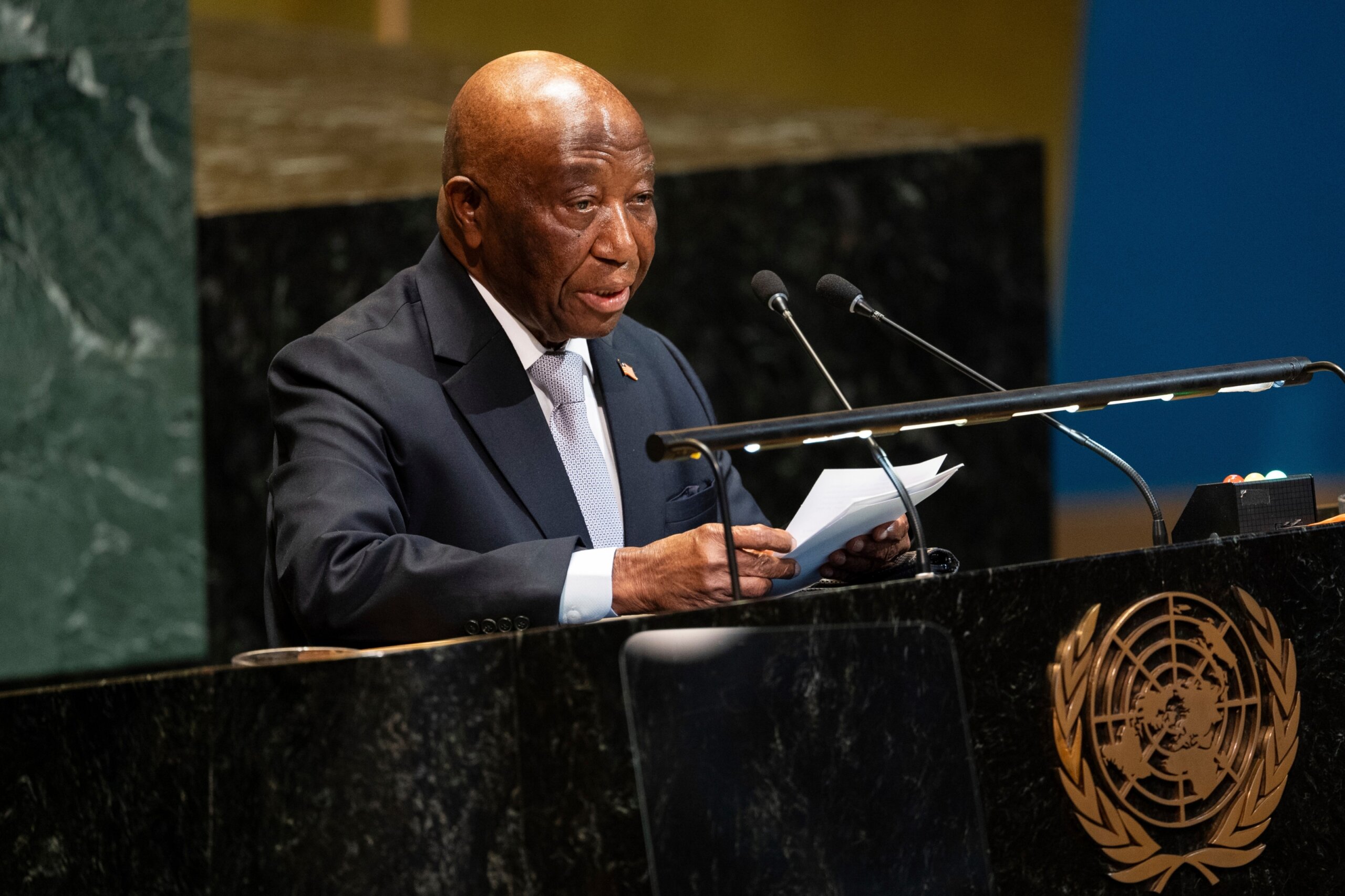
Zelenskyy details rift with dismissed defense minister, saying some of his actions were misguided

KYIV, Ukraine (AP) — Ukrainian President Volodymyr Zelenskyy said he believes actions taken by dismissed Defense Minister Mykhailo Fedorov, including his involvement in mass protests and calls for elections, were misguided, as he publicly detailed their dispute for the first time.

Zelenskyy also alluded to problematic decisions over defense spending and said inaccurate information provided by the Defense Ministry contributed to an awkward encounter with U.S. President Donald Trump over the use of Starlink in Russia.

Zelenskyy disclosed figures showing Ukraine’s growing shortage of Patriot air-defense missiles needed to counter Russian ballistic attacks, with deliveries from Western allies declining in the past three years even as Russian missile strikes intensified.

He highlighted battlefield gains, however, saying Ukrainian forces have almost completely recaptured the Dnipropetrovsk region, with only about 10 square kilometers remaining under Russian control.

He made the remarks during a two-hour off-the-record meeting with reporters on Saturday, with a transcript released publicly on Sunday.

Wide-ranging discussion included first public comments on Fedorov dismissal

His comments ranged widely, covering the latest battlefield developments, efforts to counter Russian ballistic attacks, the state of peace negotiations, Ukraine’s budgetary challenges and the political turmoil surrounding Fedorov’s dismissal.

“I really had and still have a very positive attitude toward Mykhailo. We have been through a lot together. But I believe that he himself goes, or is pushed, into the wrong things,” he said.

Fedorov, a popular minister credited with modernizing Ukraine’s armed forces and accelerating the military’s embrace of technology and drone warfare, was dismissed last month after reportedly falling out with the country’s top military commander. His removal triggered mass protests that lasted for weeks but ultimately failed to force a reversal of the decision. Fedorov later called for elections in a video address.

Zelenskyy said he had offered Fedorov four different options to continue working in government. Fedorov, he said, rejected all four proposals.

Inaccurate information led to uncomfortable White House situation

Zelenskyy appeared to link Fedorov to an awkward episode involving Starlink and Elon Musk. Zelenskyy said that earlier this year the Defense Ministry had told him that SpaceX had agreed to allow Ukraine to use Starlink over Russian territory to carry out deep strike operations, subject to political approval.

Acting on that, Zelenskyy said, he raised the issue directly with U.S. President Donald Trump. He told Trump that Musk had confirmed the proposed use. Zelenskyy said the two sides subsequently sought Musk’s confirmation and discussed financing for the project.

But at a later meeting, Zelenskyy said Trump told him that Musk had rejected the proposal and accused him of having misled the U.S. president. Musk considered the move a dangerous escalation, according to Zelenskyy.

“He said that I had supposedly deceived him because Musk had denied Ukraine the use of Starlink on Russian territory. I went back to our Ministry of Defense and they said that maybe it was so,” he said.

Zelenskyy did not explicitly accuse Fedorov of lying. He said this episode was among the reasons behind “some of the steps.”

Zelenskyy also pushed back against protesters’ vilification of former army chief Oleksandr Syrskyi, whom he dismissed, and current Defense Minister Maj. Gen. Yevhen Khmara, saying they had gone too far.

“Maybe someone doesn’t like Syrskyi for one reason or another. But the slogans ‘Syrskyi is the devil, Khmara is the devil,’” he said. “Listen, this is too much. Do you understand? In principle, you can’t treat the military like this and tolerate it, especially when it was the military that made it possible for any peaceful protests to take place in the Ukrainian capital at all.”

Pressure on defense budget but military successes

The president also described severe financial pressure on Ukraine’s defense effort. He said the Defense Ministry faced a $27 billion budget shortfall after spending decisions earlier in the year brought forward funds originally intended for the second half of 2026.

Touching on a corruption probe that led Zelenskyy to fire one of his most senior officials this week, he said anti-corruption investigators do not believe the president was involved. The investigators had named a deputy head of the presidential office among the suspects in a money-laundering case.

“The heads of anti-corruption agencies have zero questions for me. They understand perfectly well that I am not involved in anything like that. And this is important to me,” he said.

On the battlefield, Zelenskyy was optimistic, saying Ukraine had almost completely regained control of the Dnipropetrovsk region, with only about 10 square kilometers and three small villages remaining outside Ukrainian control.

He said another operation was underway elsewhere and that its results were expected by the end of August.

He also predicted that by the end of 2026 Ukraine could reach parity between the territory occupied by Russia since the beginning of the year and the territory retaken by Ukrainian forces. Zelenskyy said Russia had occupied about 990 square kilometers since the start of the year, while Ukraine had restored control over roughly 820 square kilometers.

The president said Russia’s principal objective remained the Konstantynivka-Sloviansk-Kramatorsk axis and that Moscow was still demanding Ukraine withdraw from the Donbas region as a condition for a settlement.

Still struggling for access to Patriot missiles

Zelenskyy said Ukraine was receiving substantially fewer Patriot interceptor missiles even as Russian ballistic attacks are increasing.

He said Ukraine received 675 Patriot missiles in 2023, compared with 364 in 2025 and an expected 264 in 2026. Zelenskyy said he wanted to secure 300 additional Patriot missiles for the coming winter, while Ukraine’s Air Force had requested 360.

The shortfall is particularly serious because the United States and European partners are struggling to expand production. Zelenskyy said he hoped Ukraine could obtain even 5% or 10% of U.S. reserves and was able to pay for them.

Zelenskyy said Russia could eventually produce up to 1,300 ballistic missiles a year, compared with an estimated current capacity of 600.

He said Ukraine was also preparing alternatives to Starlink, including a European communications project, as Russia and China work on their own competing system.

In other developments

— Debris from a Ukrainian drone hit two industrial facilities including a warehouse belonging to online retailer Ozon, local officials in Russia’s Orenburg region said Sunday.

As well as shifting the war onto Russian soil through long-range drone strikes on oil facilities that have caused fuel shortages across Russia, Ukraine has unsettled the Russian public by striking warehouses of online retailers, including the country’s biggest online retailer, Wildberries, and competitors such as Ozon.

— One person was killed and six wounded in Ukrainian drone attacks on Russia’s Belgorod border region, local authorities said Sunday.

Pete Buttigieg returns to first-in-the-nation South Carolina with a fresh appeal to Black voters

Orangeburg, South Carolina (CNN) — Pete Buttigieg has been to this small but historic city in South Carolina’s Midlands at least twice before, as an underdog presidential candidate in 2020 and then as the better-known transportation secretary under President Joe Biden in 2023.Now a private citizen eying a second White House bid, Buttigieg returned this weekend with renewed urgency, appealing to Black voters who have newly solidified influence in the 2028 nominating process and whom he failed to win over in his last presidential campaign.Buttigieg told party activists during a morning speech in Florence that Republicans were using redistricting as “the culmination of a generational project to dismantle Black representation.” He held a roundtable with students at a historically Black college where he discussed his idea of reparations for slavery. And during an evening speech to the storied NAACP branch here, he said President Donald Trump’s second term may feel all too familiar to activists who fought for civil rights in Orangeburg in the 1960s.“The mid-2020s does not represent our nation’s first experience with corruption and self-dealing, with bigotry and exclusion, with inequality and injustice, with undemocratic behavior or with political violence,” Buttigieg said, adding that prior struggles played out “not on some distant shore, but in places like Orangeburg.”With a midterm election looming where both parties are campaigning over the cost of living, Buttigieg chastised fellow Democrats whom he said prefer to prioritize economic concerns over tackling more fundamental questions about democracy. He argued that civil rights legends such as Martin Luther King Jr. and Rev. Jesse Jackson have shown that Americans “can — and we must — do both.”His trip to South Carolina, Buttigieg’s first since leaving the Biden administration, marked the beginning of a new phase of political maneuvering ahead of the next presidential election, with Buttigieg making a concerted effort to get in front of Black voters and demonstrating new bonafides from his transportation secretary tenure.It was also the first major visit by a potential 2028 candidate to the state since the Democratic National Committee voted on August 15 to keep it as the location for the first presidential primary in the nation, a nod to the political power of its large Black electorate.Buttigieg brushed off a question about his 2028 plans after his speech in Florence, telling reporters he is “totally focused on 2026.” But there were ample reminders of speculation about his next move on Saturday, including a scattering of homemade signs reading “PETE” and “2028” that sprung up when he took the stage. Surveying the enthusiastic crowd, he observed he should “come here more often.”One fan, 64-year-old retiree Karen Ench, wore a “Pete Buttigieg 2028” shirt to the speech. Contemplating his 2028 ambitions afterward, she said she thought he was “really taking it much more serious” and focusing on areas of improvement from 2020.A 2028 bid would undoubtedly start with higher expectations for the onetime mayor of South Bend, Indiana, compared to his first run.“The Pete Buttigieg of 2020 is not the Pete Buttigieg of 2026,” said Marlon Kimpson, a Black former state senator who backed Biden in the 2020 primary. “He has name recognition, he’s no longer introducing himself. I think people generally like Pete, and that’s a big deal in an open race because he starts out at a plus. But as we look at his economic agenda, just for the average South Carolinian, with emphasis on the African American community … and the political infrastructure he has deployed in our state, there will be questions with respect to those issues.”Buttigieg’s 2020 campaign, despite winning the Iowa caucuses with a much Whiter demographic, came to an end in South Carolina, dogged by his weaknesses with Black voters. After powerful South Carolina Rep. Jim Clyburn endorsed Biden and gave his flagging bid a shot of momentum that ultimately propelled him to the presidency, Buttigieg finished fourth in the Palmetto State and dropped out a day later.Biden received 61% support from Black voters in South Carolina, while Buttigieg got 3%, according to exit polls.Colleen Condon, a Charleston lawyer and longtime party activist who backed Buttigieg in 2020, said that “2020 is so hard to compare against” due to the unique circumstances of Clyburn’s support for Biden. Now, Condon, who is White, said, Democrats are “anxious for someone young and energetic” and noted Buttigieg would bring more experience to the 2028 race.“He has done a lot of work in the last eight years, (including) as secretary of transportation, in showing his ability to work on the federal level,” Condon said.‘What he’s actually done’In interviews across the state on Saturday, Black Democrats agreed Buttigieg’s experience as transportation secretary has distinguished him since he last sought their support. He played a high-profile role in promoting Biden’s bipartisan infrastructure law, visiting communities small and large across the country to announce funding for long-awaited projects.In Florence, Mattie Thomas, a member of the South Carolina Democratic Party executive committee, said she did not know about his time as mayor but now she sees him as “one of our best transportation secretaries.”“I think he’ll fare extremely well this go around because people, they’ve seen what he’s actually done,” Sandra Burgess Glover, a retired educator, said in Orangeburg as Buttigieg mingled with the dinner crowd before his speech.Buttigieg was showered with praise at the dinner for his June 2023 announcement in the city with Clyburn of a $23 million federal grant to better connect Orangeburg’s two HBCUs to downtown. Orangeburg Mayor Michael Butler prompted a standing ovation for Buttigieg when he brought up the project, calling it “a long time coming.”Deloris Frazier, a member of the Orangeburg County Council, embraced Buttigieg as he worked the crowd before the dinner, telling him that she keeps a photo in her home of the two of them from that day in 2023. She told CNN afterward that she’d support Buttigieg for president if he ran, joking that she would take the photo and “just blow it up and make it bigger.”Earlier Saturday, Buttigieg visited one of Orangeburg’s HBCUs, Claflin University, and held an hourlong roundtable with about 20 students. The conversation topics ranged from artificial intelligence to reparations for slavery, which was a litmus test in the 2020 primary.Buttigieg said he still supported legislation to create a commission to study reparations. But he said he learned as transportation secretary that the federal government could take “reparative” steps sooner, pointing to his efforts to combat decades-old urban planning that led to highways cutting across Black neighborhoods.“I have a perspective on that that I didn’t have before when I didn’t have a chance to work on federal policy,” Buttigieg said.Usir Jackson, the president of the Student Government Association, said afterward he found Buttigieg “down to earth” and “authentic.”Buttigieg, who took notes at some points, appeared moved when the roundtable topic turned to young voters feeling disillusioned – and Jackson shared why he still makes sure to vote.“I do it to respect people who came before me,” Jackson said, “so I could vote.”Hurdles remain with Black votersFor all the praise of his record in the Biden administration, some of Buttigieg’s admirers acknowledge he needs it to translate into far more Black voter support than he saw in 2020.While the crowd he spoke to in Orangeburg was overwhelmingly Black, the audience that came to see him earlier in the day in Florence, at the state Democratic Party’s Spratt Issues Conference, was mostly White.State Rep. JA Moore was a crucial Black supporter for Buttigieg in 2020 in South Carolina, backing him after then-California Sen. Kamala Harris dropped out. Moore said in an interview that any potential 2028 candidate needs to focus less on tailoring a message to Black voters and more on developing a “cadence” of regularly reaching out to them where they are.“What we call it is the difference between a ‘come here’ and a ‘been here,’” Moore said. “I think one of the things people missed about Joe Biden – he was a ‘been here’ in the sense that he had been coming to South Carolina for over 40 years.”Some Black Democrats said he may continue to face hurdles in the state as a gay man, an issue that came up in 2020 as he reached out to socially conservative church congregations. “This is the Bible Belt,” Thomas said matter-of-factly.“Sometimes they want to categorize a candidate or individual because of their sexual preferences,” said Brenda Montgomery, a 67-year-old training specialist from Lake City who saw Buttigieg in Florence. “But for me, he is everyone. He represents everyone, and I really like him as a person because he is approachable.”Buttigieg, whose crowd in Florence was dotted with some small rainbow flags, does not go out of his way to talk about his sexual orientation. But on Saturday, he spoke regularly about his two children, who are mixed-race, that he adopted with his husband, Chasten, noting fatherhood is the biggest personal change he has experienced since 2020.It’s a life change that would be put to the test by another grueling presidential campaign, which South Carolina Democrats see as likelier than ever. While he mostly avoided talk of 2028, he said in Florence that he was excited about South Carolina’s first-in-the-nation status and how it would spotlight the state’s diversity.Buttigieg has fielded the 2028 speculation by becoming one of the most prolific endorsers in the midterms, with an eye on supporting Black Democrats and Democrats running in Republican-leaning territory. He kicked off his South Carolina trip on Friday night by headlining a fundraiser in Charleston for Nancy Lacore, a retired Navy officer running for an open House seat in a district that Trump carried by 13 percentage points in 2024.Condon, the Democratic activist who helped host Buttigieg’s fundraiser for LaCore, said it was “extremely early, but I’m very inclined to” support Buttigieg again in 2028 if he runs.Moore said it was too early for endorsements but said he especially likes Buttigieg for at least one reason.Buttigieg “has the ability to learn and adapt,” Moore said. “I find that refreshing and appealing.”The-CNN-Wire™ & © 2026 Cable News Network, Inc., a Warner Bros. Discovery Company. All rights reserved.
Read Next Story