
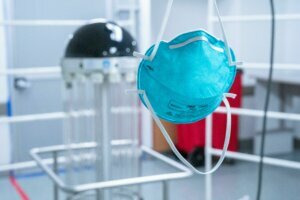
Having the right tool for the job makes the challenge safer and faster — a new robot at UVA Health, in Charlottesville, Virginia, is helping quickly disinfect N-95 face masks for health care professionals handling coronavirus cases.
With the greatest anticipated number of patients infected with COVID-19 still to come in Virginia, the health system has acquired, assembled, and trained on a new robot that will allow its facilities, including the hospital on the University of Virginia campus, to reuse the crucial personal protective equipment.
The robot, called “Tru-D,” stands 5 feet, 6 inches tall and uses ultraviolet germicidal irradiation (UV) or UV light vectors to disinfect porous and non-porous surfaces without toxic chemicals.
According to the university, the $100,000 robot can disinfect up to 6,000 N-95 masks daily. Masks are draped over racks that surround the robot.
How does it work?
The high energy from UV light is absorbed in the cellular RNA and DNA of microorganisms, damaging nucleic acids and preventing them from reproducing. Because they cannot survive, they ultimately cannot infect humans.
The robot can disinfect hundreds of masks per 20-minute cycle. To prepare the masks for disinfection and recover them for repackaging takes about an hour.
“The robot uses size and density sensors to calibrate the exact dose of energy necessary to disinfect the entire room. Light is emitted, then reflected back so all surfaces receive the required energy,” said Dr. Carlene Muto, assistant professor of infectious diseases and international health.
“This ensures ‘Total Room Ultraviolet Disinfection (Tru-D)’ of all surfaces, including shadowed or hidden areas. Use of reflective surfaces increases the efficiency of the device, so the room was painted with reflective paint.”
The robot’s manufacturer is Tru-D SmartUVC, located in Memphis, Tennessee.