
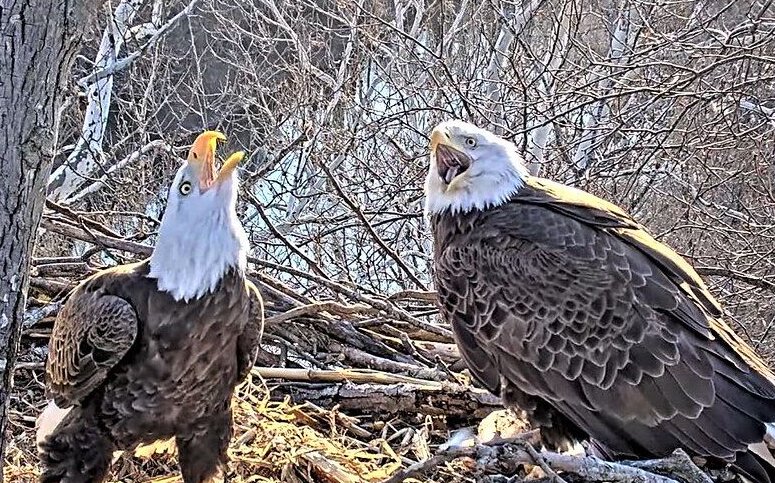
The Dulles Greenway bald eagle cam has watched the lives of Rosa and Martin in their nest for a few months now.
They welcomed two eggs in February. And this weekend, Terry Hoffman began to see signs of the little eaglet.
“We started to see a pip — when you see a small crack on the egg,” said Hoffman, the public and customer relations manager for the Dulles Greenway. “And once you see that, it takes 24 to 48 hours for the eaglet to break out the shell.”
Bald eagles typically lay up to three eggs a year, which typically take about 35 days to hatch, according to the National Eagle Center.
“I feel like a proud papa. It’s like a little bobblehead. It’s struggling to stay up and it’s trying to eat,” said Hoffman.
Now, the eaglet will go through rearing as it prepares to take on the world on its own in about 10 to 12 weeks.
Since setting the camera up last year, Hoffman said, they have 20 volunteers answering questions through the chat. They’ve all been keeping a close eye on that second egg, anxiously waiting.
The most rewarding part, he said, is allowing Loudoun County schools to use the eagle cam as an educational tool.
“I think the project has definitely been a success. When we envisioned this, we wanted the school system to utilize our cameras,” he said.
Hoffman and others with the Dulles Greenway are now waiting for the second egg to hatch before deciding on what to name the eaglets.
“Before the end of this week, it should be hatching,” he said.
They will then decide whether they’ll hold a naming contest on social media.


