
▶ Watch Video: Excessive heat expected to affect over half of Americans this week, forecasters say
The heat taking over much of the U.S. was nearly deadly for a baby in South Texas, with a viral video showing people having to break through the car’s windshield to save him after he was accidentally locked inside with the keys. While the baby was saved and is believed to be OK, the incident is highlighting just how catastrophic extreme heat can be in parked vehicles.
Extreme heat is the No. 1 weather-related killer in the U.S. Even when temperatures outside seem relatively low compared with what’s been experienced in recent weeks, parked vehicles essentially become ovens under the sun’s rays.
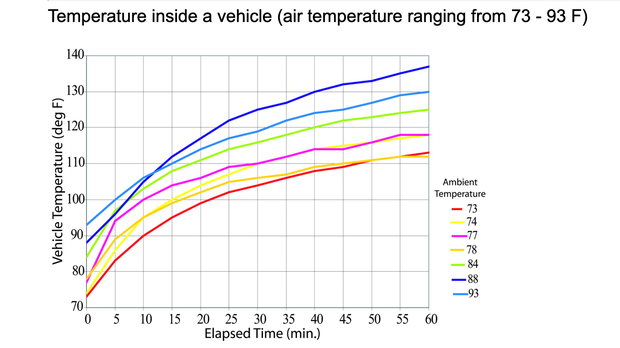
So, how hot can a car get in the sun? All it takes is an 80-degree Fahrenheit day to bring the normal car temperature to triple digits.
After just 20 minutes on an 80-degree day, the CDC says the inside of a car can hit 109 degrees Fahrenheit. After 40 minutes, it hits 118 degrees, and after an hour, it can hit 123 degrees. That means that on days when cities are experiencing triple digits temperatures —like Phoenix has been for weeks on end— those temperatures become even hotter in a short amount of time.
“Cars can quickly heat up to dangerous temperatures, even with a window cracked open,” the CDC says. “While anyone left in a parked car is at risk, children are especially at risk of getting a heat stroke or dying.”
Objects within the car can get even hotter, posing a risk of burns.
According to the National Weather Service, the atmosphere within the car is “warmed little” compared to that of the objects within the car. A dark dashboard or a seat, for example, “can easily reach temperatures in the range of 180 to more than 200 degrees Fahrenheit,” the agency says.
“These objects (e.g., dashboard, steering wheel, childseat) heat the adjacent air by conduction and convection and also give off longwave radiation (red) which is very efficient at warming the air trapped inside a vehicle,” the agency added.
In Phoenix, which has seen weeks on end with triple-digit temperatures, Dr. Kevin Foster of the Arizona Burn Center told NPR that seat belt buckles can also get so hot that they lead to burns.
“The interior of an automobile, particularly one with dark upholstery, can get to be 160 or 170 degrees,” Foster said. “The worst thing to do is to touch something that’s metal inside the car that’s been exposed to direct sunlight like a seat belt buckle.”
When it comes to car safety in the heat, various agencies share one common message: “Do not leave children or pets in a closed vehicle with the windows up.”
The National Weather Service also recommends that in persistent heat waves, people should stay hydrated and avoid excessive alcohol, wear loose-fitting, lightweight and light-colored clothing, avoid going out during the hottest times of the days, and eat frequent, small meals rather than heavy meals.