This article was written by WTOP’s news partner, InsideNoVa.com, and republished with permission. Sign up for InsideNoVa.com’s free email subscription today.
During the COVID-19 pandemic, Dr. Terry Clower moved from Fairfax County to a house on the water in Stafford County and obtained a 30-year mortgage at a 2.75% interest rate.
“I like my house,” Clower said. “I love my mortgage. I’m never leaving that house.”

That is an example of the challenges facing both Northern Virginia and the housing market, Clower said at the Mount Vernon Springfield Chamber of Commerce’s annual Economic Outlook breakfast on Thursday.
Clower, director of the Center for Regional Analysis at George Mason University, provided an overview of the region’s economy for the more than 100 attendees at the breakfast, at Belle Haven Country Club. He noted that while the Northern Virginia economy is resilient and the unemployment rate is low, there are headwinds.
“We’ve lost a bit of our mojo,” Clower said.
Among the challenges is that the Washington region as a whole has seen a significant slowdown in population growth — and Fairfax County’s population actually dropped by 3,400 people between July 2021 and July 2022, according to Census estimates.
“That’s a scary number,” Clower said.
Prince George’s and Montgomery counties in Maryland, as well as the city of Manassas Park in Virginia, also lost population during that time. The Washington region’s population as a whole grew by only 8,800 — and that was entirely due to people moving into the area from other countries.
“In a region this size, that’s a statistical blip,” Clower said. “This problem is getting worse…. We’re losing millennials who’ve decided they can’t afford $1.3 million for a single-family home in Arlington.”
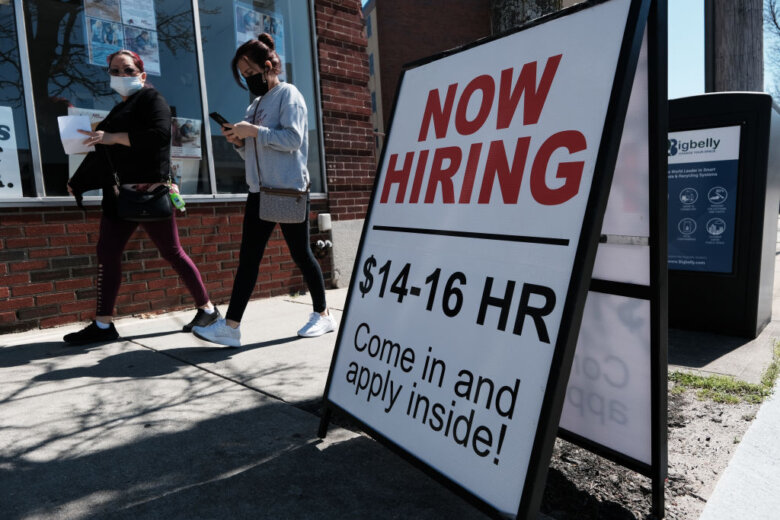
The challenge for businesses is that the decline in population makes it more difficult to find workers.
“Businesses follow the workers, and we’re losing folks,” he said. “You can’t grow a company if you can’t add more workers.”
He also noted that, like him, the number of people who bought houses or refinanced their mortgages when rates were at historic lows over the past few years aren’t likely to move again anytime soon, which will affect the real estate market and the inventory of available homes. He said he doesn’t expect the Federal Reserve Bank’s efforts to curtail inflation by raising interest rates to achieve its full effect until 2025.
Another speaker at the event, David Boyle, chair and CEO of Alexandria-based Burke & Herbert Bank, said he is particularly worried about the office market, although his bank has limited exposure in that area.
He said that the true office vacancy rate in the District of Columbia is around 60%, as many employers embrace hybrid or remote work.
“It’s very, very challenging,” Boyle added. “We’re seeing building owners give the keys back to lenders.”
At the same time, he noted, deposits in banks across the country declined by $600 billion in the first quarter of this year, which means banks have less money to lend.
“We’re seeing a number of banks in this market slow down or contract on their lending,” Boyle said. “The lending constraint is going to slow down growth and development.”
He noted, however, that Burke & Herbert, is not among those institutions, with a loan-to-deposit ratio in the 60% range, and also that Northern Virginia is better off than many other places in the country.
“We’re not going to see the really high highs and low lows,” Boyle added. “Northern Virginia is an amazingly resilient market.”
Boyle also said that the recent failure of Silicon Valley Bank was due to “mismanagement and lack of regulatory oversight” that is not indicative of a larger banking issue, especially locally.
If there is a recession, he said, “The banks are exceptionally well-prepared for that.”