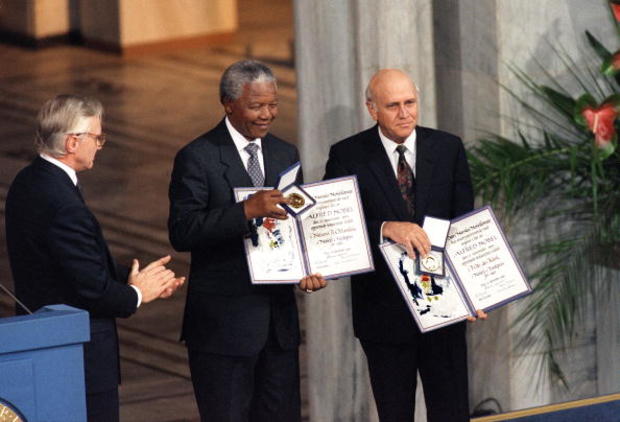
Johannesburg — The Nobel Peace Prize medal awarded to South Africa’s last apartheid president, FW de Klerk, was stolen from his Cape Town home six months ago, his foundation revealed on Wednesday. He received the prize in 1993 alongside anti-apartheid icon Nelson Mandela, for his role in ushering South Africa into democracy.
The 18-carat medal made of recycled gold was stolen from his home in a burglary in April.
“I can confirm that the Nobel Peace Prize belonging to FW de Klerk was stolen from his home earlier this year,” Brenda Steyn, the foundation’s legacy manager told AFP.
The former president died in November last year aged 85 after being diagnosed with cancer.
Mandela and De Klerk were jointly awarded the prestigious laurel in Oslo “for their work for the peaceful termination of the apartheid regime, and for laying the foundations for a new democratic South Africa.”

De Klerk led South Africa’s transition from white-minority rule to the first multi-racial elections in 1994 after freeing Mandela from prison in 1990.
Mandela then became South Africa’s first black president after his African National Congress party won the first democratic election.
De Klerk’s widow Elita Georgiades suspects a former house employee who worked for the family for seven years was behind the theft, said Steyn.
The theft was reported to Cape Town police.