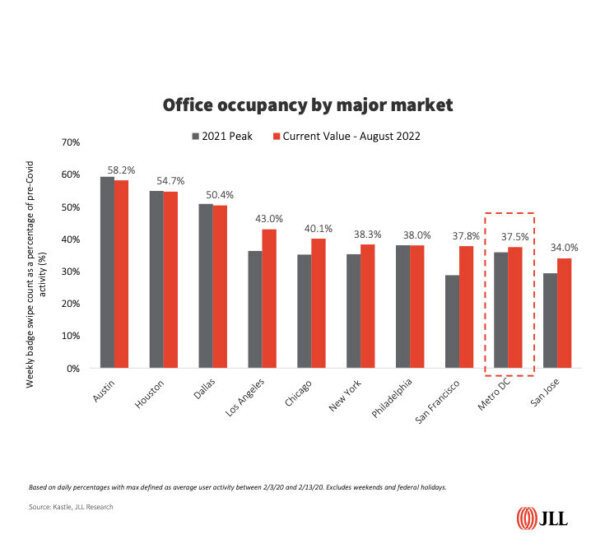
Office worker occupancy in the D.C. region remains below the national average, and among the 10 largest markets, it is currently the second lowest.
Much of that can be attributed to hybrid schedules.
Commercial real estate property company JLL recently completed its end of summer Market Pulse report on the D.C. region’s current workforce trends. It reports the average weekly office worker occupancy rate is still just 37.5%. That is off the pandemic-era peak of 41.3% in early June.
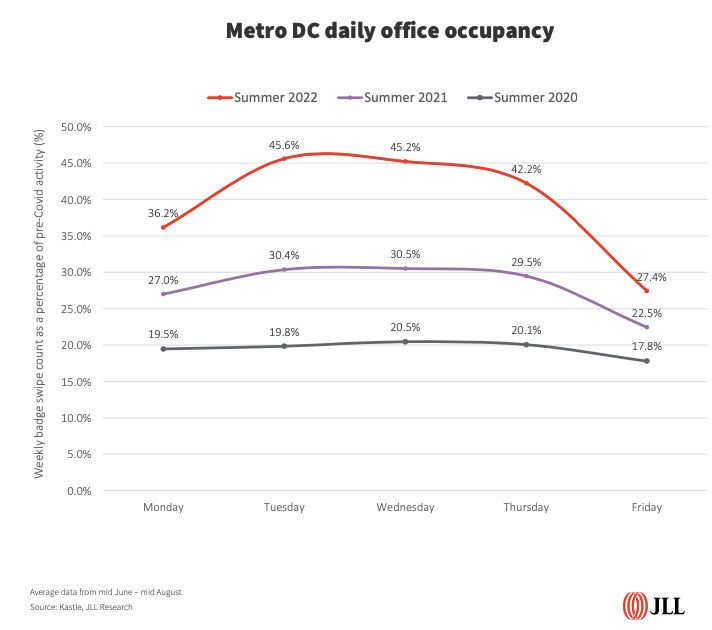
The days of the week that have the lowest average office worker occupancy show hybrid workers value Fridays and Mondays.
In August, JLL research shows office worker occupancy throughout the D.C. metro averaged 27.4% on Fridays, and 36.2% on Mondays. It peaks at 45.2% on Wednesdays.
Average weekly on-site worker occupancy in the D.C. metro ranks the second lowest, behind San Jose at 34% and just below San Francisco at 37.8%.
The highest average weekly office worker occupancy rates are all in Texas, led by Austin, Houston and Dallas, at 58.2%, 54.7% and 50.4%, respectively.
JLL’s report mirrors a similar one from Kastle Systems, which tracks building security entries by employees, pegging D.C.-area office worker occupancy holding steady at about 40%.
JLL said with summer vacations coming to an end, the post-Labor Day season will provide a much-anticipated reflection of return-to-work behavior moving forward.
Below are JLL charts tracking average daily on-site office occupancy over the past three years, in the D.C. metro, and D.C.-area occupancies compared to other metros.