
This article was written by WTOP’s news partner InsideNoVa.com and republished with permission. Sign up for InsideNoVa.com’s free email subscription today.”
Fairfax County wants the community to weigh in on the designs for each Richmond Highway Bus Rapid Transit (BRT) station launching in 2030.
The county first asked for input about potential themes in 2020 and 2021, and now it wants residents to give final input in choosing each station theme through a public survey.
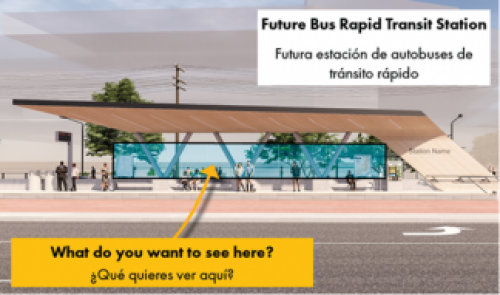
“The ‘Community Charm’ initiative focuses on integrating artwork into each BRT station to reflect the history, identity, and character of the neighborhoods surrounding each station area,” a news release reads.
Survey questions are centered on ranking the importance of culture, history and nature in each station’s artwork. The survey asks for more information on events, characteristics or cultural elements you want to see depicted for top theme choices.
Once the survey closes on Aug. 14, the county’s History Commission and Department of Planning and Development will work together to develop narratives for each station theme.
“We will be working with students from local schools to design artwork for the windscreen area, based on themes developed with the community,” the survey states. The designs and narratives will then be presented to the community for feedback, and the BRT’s Executive Committee will vote on the final designs.
The BRT, also named The One (Richmond Highway is U.S. 1), will have nine stations, constructed in two sections, and will connect to areas of major employment, shopping centers and residential communities along the Richmond Highway corridor. The idea of working with residents to design the system comes from a Virginia Department of Rail and Public Transportation study.