Leisure travel has returned for airlines and hotels, but business travel remains significantly lower than pre-pandemic levels, and the D.C. area will be among the hardest hit this year.
The D.C.-based American Hotel & Lodging Association has released a report on the state of business travel for 2022, and it predicts spending will be 23% below pre-pandemic levels nationwide. For the D.C. market, the deficit is double the national drop — an estimated 54.4%.
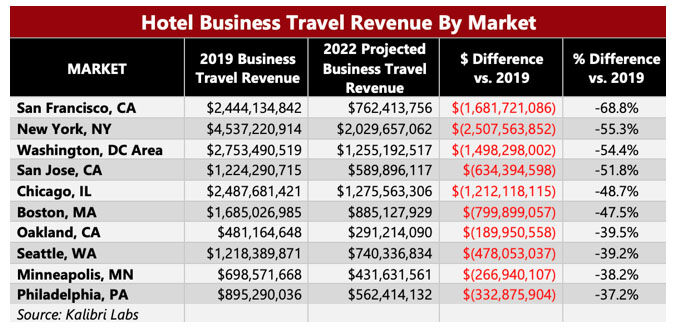
That translates into nearly $1.5 billion in business travel spending — including corporate, group, government and other commercial categories — D.C.-area hotels won’t see compared to 2019, a drop from nearly $2.8 billion to a projected $1.26 billion.
The D.C. metro area ranks behind only San Francisco and New York City in projected loss in business travel spending this year. San Francisco is expected to lose $1.7 billion compared to 2019, a 68.8% drop. New York City’s deficit is a projected $2.5 billion, or 55.3%.
AHLA’S report was done in conjunction with Potomac, Maryland-based hotel benchmarking consultant Kalibri Labs, which holds the largest database of U.S. hotel bookings.
This year’s losses come after the hotel industry lost an estimated $108 billion in business travel revenue during 2020 and 2021 combined.
Leisure travel is expected to return to pre-pandemic levels this year. Business travel, the hotel industry’s largest source of revenue, will take significantly longer, said the American Hotel & Lodging Association.
“While dwindling COVID-19 case counts and relaxed CDC guidelines are providing a sense of optimism for reigniting travel, this report underscores how tough it will be for many hotels and hotel employees to recover from years of lost revenue,” said Chip Rogers, president and CEO of AHLA.
“The good news is that after two years of virtual work arrangements, Americans recognize the unmatched value of face-to-face meetings and say they are ready to start getting back on the road for business travel,” he added.
AHLA points to its own surveys that found 80% of employed Americans and 86% of business travelers say face-to-face interactions are important for maximizing company success.
Below are the 10 metros AHLA’s report found will be hardest hit by the continued loss of business travel spending: