
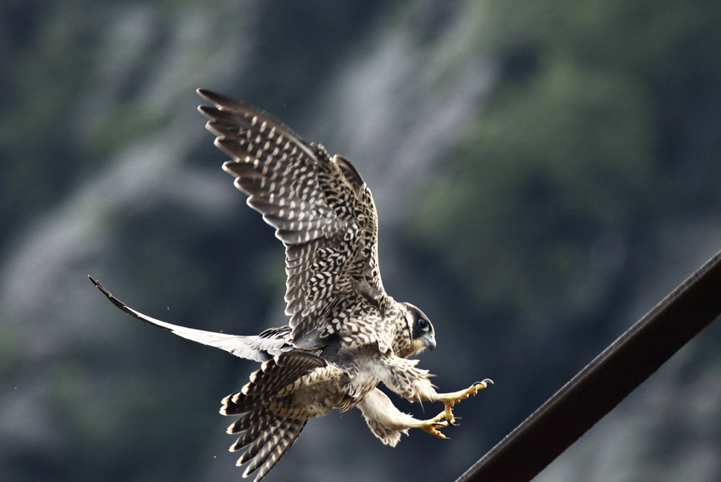
Harpers Ferry National Historical Park has a new feathered flyer.
According to the National Park Service, a peregrine falcon chick is getting its wings in gear at the site for the first time in 70 years.
“The National Park Service is thrilled to see a fledging at Harpers Ferry and are grateful to the many partners and volunteers who have helped us study, monitor and protect peregrine falcons,” Chief of Resources Management Mia Parsons said. “We hope that this is the first of many successful breeding seasons for these peregrines.”
The agency said peregrine falcons are widely known as the fastest birds in the world, reaching speeds of up to 240 mph in a hunting dive or “stoop.”
The falcons were known to nest on Maryland Heights until the early 1950s, when their numbers declined throughout North America and Europe, owing primarily to reproductive failure caused by the extensive use of pesticides such as DDT.
According to the park service, by the mid-1960s, the peregrine falcon population in the Western U.S. had declined by an estimated 80% to 90%, and the entire eastern population had been made locally extinct.
The agency said staff will continue to monitor and protect peregrine falcons in the park. Partial closures of the cliff to hiking and rock climbing are in place to ensure that the nest site is protected from human disturbance.