
WASHINGTON — Local authorities indicate that Thursday morning’s test of the wireless emergency alert system in the D.C. area was an overall success, but citizens noticed glitches in the process.
The system — which allows text-like messages and an audible alarm to be sent to devices in specific geographic locations — is intended for serious events such as dangerous weather or Amber Alerts.
Sara Allen, traveling on a Metro train, received five alerts on her work phone, but none on her personal mobile device.
“That makes me a little nervous. If I (didn’t) have my work phone, I wouldn’t have known about it.”
Zeke Hartner, a WTOP assistant editor, was also riding Metro.
“Around 10:05 a.m., I was at Metro Center Station, waiting for my train. Then I started hearing the alert tones going off on other people’s phones.”
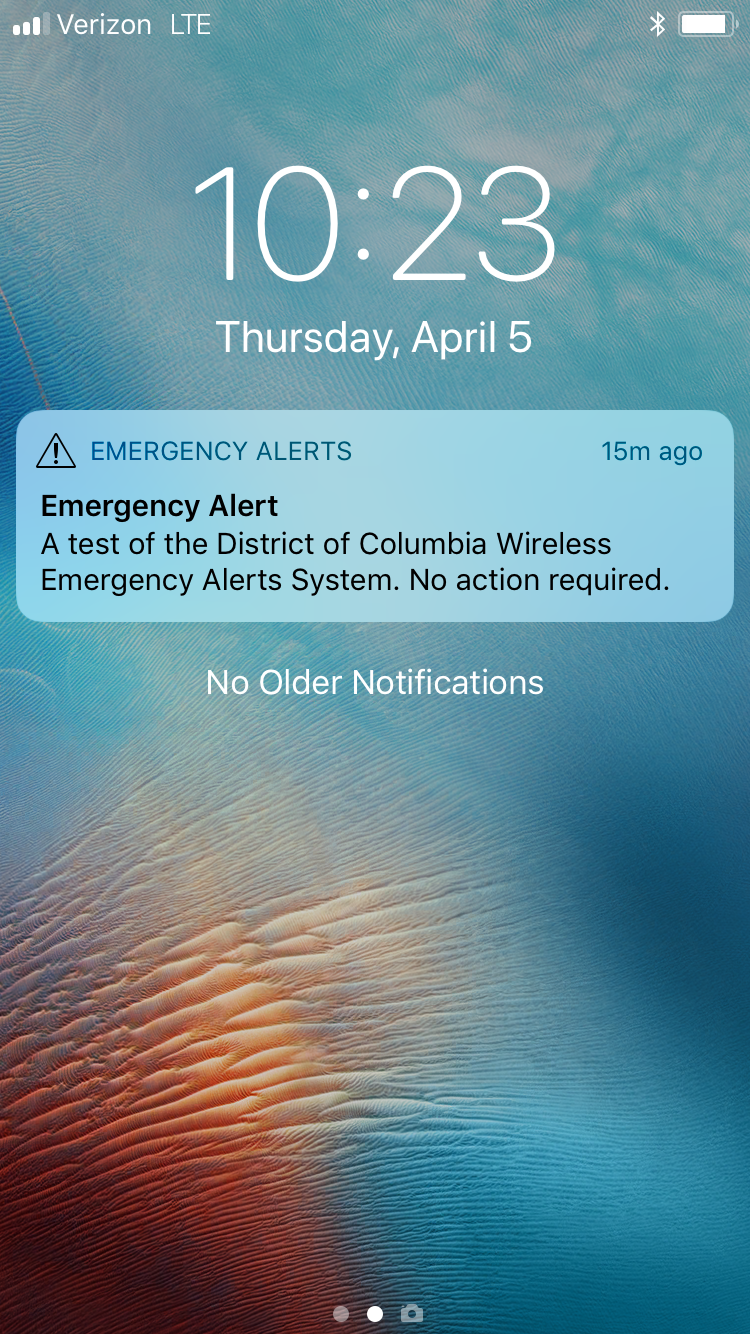
Hartner, aware the test was coming, expected something on his phone but got “nothing.” His phone received neither the audio tone nor the text message.
Twenty area jurisdictions took part in Thursday’s test, which was scheduled for 10 a.m. to 11 a.m. A text message and loud noise was repeated twice as part of the test.
“The test was a success,” according to Chris Rodriguez, director of the D.C. Homeland Security and Emergency Management Agency. “For the District of Columbia, we were very satisfied and encouraged by the way the system worked.”
Asked why recipients of the alerts had differing experiences, Rodriguez said, “That would be a carrier issue. We do know that there are people (who) have two phones, and those two phones could have different carriers on each of those devices.”
There were no message dissemination anomalies during the test, said Rodriguez, which led him to believe the discrepancies were carrier-driven.
The Metropolitan Washington Council of Governments subcommittee for wireless emergency alerts began planning the test in the fall of 2017.
“The objective of the test was to ensure that the capability could be deployed on a moment’s notice. And it’s important for us to test that capability, not only for the District of Columbia, but for the region,” said Rodriguez.
“If there was an event,” said Rodriguez, “a terrorist attack or a major weather event that was going to the nation’s capital, it has cascading impacts across the region.”
The Council of Governments has set up a short online survey to get an idea of everyone’s experience.
The results will be used to assess the system’s readiness and to identify possible improvements.
WTOP’s Jack Pointer contributed to this story.