
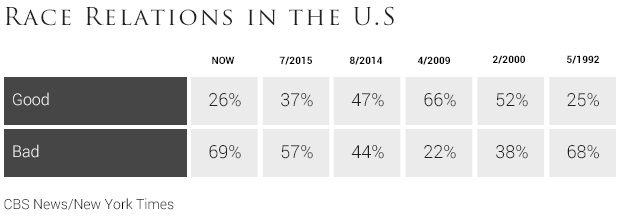
Following the shooting of two black men by white police officers in Louisiana and Minnesota and the subsequent shooting of five police officers by a black gunman in Dallas, negative views of race relations in the U.S. have risen to a level not seen since the 1992 Los Angeles riots that followed the Rodney King verdict. Now just 26 percent of Americans think race relations in the U.S. are mostly good – an 11 point drop from a year ago – while 69 percent say they are mostly bad. Back in May 1992, 68 percent said race relations were bad.
Positive opinions of race relations rose above 50 percent in the 2000s, and reached a high of 66 percent in April 2009, shortly after President Barack Obama took office. But those positive assessments have been dropping steadily since mid-2014, after the conflicts between blacks and the police in Ferguson, Missouri following the shooting of Michael Brown by a white police officer.
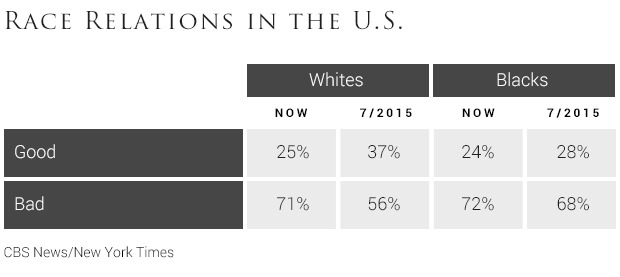
White Americans have traditionally been more optimistic about race relations than black Americans, but in this poll their views are similar: whites are just as pessimistic as blacks about the state of race relations in the U.S.
And there is growing pessimism about whether race relations are improving. Now just 9 percent of Americans think race relations are getting better, while 59 percent think they are getting worse. A year ago, 21 percent thought race relations were improving, and 38 percent thought they were getting worse.
The Shooting in Dallas
Most Americans have heard or read a lot about the events in Dallas, and 54 percent were surprised by the shooting of the Dallas police officers. But while 55 percent of whites say they were surprised by the shooting, just over half blacks – 52 percent – say they were not surprised.
Black Lives Matter
More Americans agree with the Black Lives Matter movement (41 percent) than disagree (25 percent), though about a third don’t have an opinion either way. Seventy percent of black Americans agree with the Black Lives Matter movement, while white Americans are more divided, with 37 percent agreeing, 31 percent disagreeing, and 28 percent with no opinion on the movement.
Assessing the Police
Despite increasing scrutiny of police tactics following a number of civilian deaths at the hands of police caught on video over the last two years, three in four Americans give police in their community positive marks for doing their job. There are racial differences in this assessment, however. While eight in ten white Americans think their local police are doing at least a good job, less than half of black Americans agree. Instead, 57 percent of blacks rate their local police as either fair (34 percent) or poor (23 percent).
Eighty percent of Americans overall and 85 percent of white Americans say their local police make them feel mostly safe — but just over half of black Americans agree. Forty-five percent of black Americans say the police make them mostly anxious. These percentages have changed little since 2014.
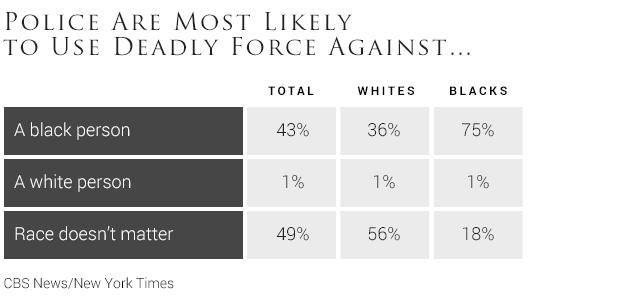
Three in four blacks also think the police are more likely to use deadly force against a black person than a white person. Most white Americans – 56 percent – think race doesn’t make a difference in the use of deadly force by police.
This poll was conducted by telephone July 8-12, 2016 among a random sample of 1,600 adults nationwide. Data collection was conducted on behalf of CBS News and The New York Times by SSRS of Media, PA. Phone numbers were dialed from samples of both standard land-line and cell phones.
The poll employed a random digit dial methodology. For the landline sample, a respondent was randomly selected from all adults in the household. For the cell sample, interviews were conducted with the person who answered the phone.
Interviews were conducted in English and Spanish using live interviewers.
The data have been weighted to reflect U.S. Census figures on demographic variables.
The error due to sampling for results based on the entire sample could be plus or minus three percentage points. The error for subgroups may be higher and is available by request. The margin of error for the sample of whites is three points and for the sample of blacks nine points. The margin of error includes the effects of standard weighting procedures which enlarge sampling error slightly.
This poll release conforms to the Standards of Disclosure of the National Council on Public Polls.
This article was republished with permission from CBS News.