
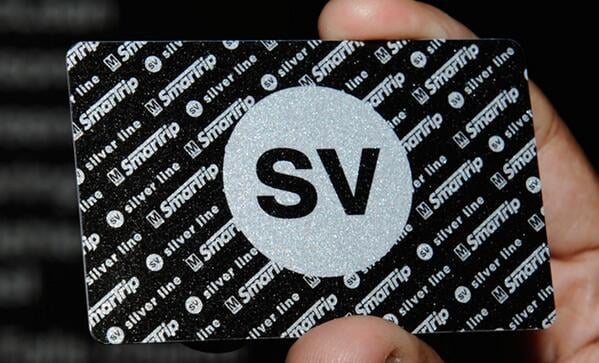
Metro answers Silver Line questions in online chat

Commemorative SmarTrip  Card/Credit: MetroLynn Bowersox, Metro’s assistant general manager for customer service, communications and marketing, answered questions from future Silver Line readers recently in an online chat hosted by The Washington Post.

After five years of construction and more than six months of recent delays, the Silver Line will open on Saturday, July 26, Metro officials said last week. The first train will leave the Wiehle-Reston East station at noon.

Here are some of the chat highlights.

Q: Is this line similar in nature to the MARC, but it just happens to run parallel to the Blue Line in some parts, use the same rails and stations to the Blue & Orange lines?

A: The Silver Line will look and feel just like the existing Metrorail lines. There are five new stations in the first phase — four in Tysons Corner and one in Reston.  The line will serve these five new stations, and then connect them via the existing Orange and Blue lines with about 2 dozen other stations from East Falls Church, through Downtown DC, to Largo.

Q: How long will a commute take from Herndon into the city at 7:30 a.m. peak rush?

A: Herndon is part of Silver Line’s second phase, which will open in a few years.  If you’d like to check travel times from the Wiehle-Reston East station (closest to Herndon), you can do that here.

Q: Has Metro taken into account the crowds and problems on the Orange Line that will be created by running a full week of non-passenger Silver line testing starting July 20th? Orange line trains will drop back to their planned intervals when the Silver line starts, but there will be no Silver line to supplement. So we will have all the bus riders and people that would otherwise be rerouted from WFC in particular, waiting for trains at least 6 minutes or more apart. It will be a long week for commuters.

A: During the week of simulated service, those “Silver Line” trains will carry passengers between East Falls Church and Largo Town Center.  They will be labeled as Orange Line trains through that segment.  So, that week, stations like East Falls Church, Ballston and Court House will actually see a service increase.

Q: What percentage of Silver Line riders do you anticipate will be former Orange Line Riders (those for whom the Silver line will be more convenient) as opposed to new riders?

A: About 25-30 percent will be existing (Orange Line) customers.  The rest are expected to be new riders to the system.

Q: Will there be parking at Wiehle when the Silver Line begins service? Driving by this weekend, it did not look like the garage was near completion.

A: Yes it will be ready, opening at 9:30 a.m. on July 26.  For details, you can visit the LAZ Parking website at lazparking.com. (Reston Now editors note: The garage has been complete for nearly a year. What you see under construction is the future BLVD apartments that are located on top of the parking garage.

Q: Why doesn’t the Silver line just end where it connects with the Orange line and trains turn around to head back the other way towards Reston East (and eventually Dulles and beyond)?

A: I believe this option was studied as part of the planning/environmental work that was done before the line was constructed. Such an option would not attract as many riders, would result in a less convenient travel experience, and would have the effect of creating crowded platforms at East Falls Church.

Q: Will the Silver Line opening during the summer months while a percentage of people who normally commute are on vacation help or hurt as the bugs are worked out of the system? Fewer passengers might mean that fewer people are delayed if there are issues but fewer people might also mean that it won’t get a real stress test from peak passenger demand.

A:  I think it will definitely help for the reasons you’ve noted in your question.  We know from experience (e.g. Rush Plus) that commuting habits are slow to change.  It gives us an opportunity to ramp up to full ridership over the next year.

See the full chat transcript on the Washington Post site.

Photo: Silver Line commemorative SmarTrip card/Credit: Metro

Don’t Settle for Student Loans to Pay for Online Education

Online college programs are becoming a more popular choice for prospective students, with one study finding that more than 6 million students enrolled in at least one online course in fall 2015. The popularity of these courses can be attributed in part to their flexibility with working adults' schedules, students' ability to progress more quickly through online programs and, oftentimes, cheaper tuition. [See 10 low-cost online bachelor's programs for out-of-state students.]Online degrees can be beneficial to many college students, but some studies have shown online learners complete their programs at lower rates than students at traditional brick-and-mortar campuses. Individuals with student loans but no degree comprise two-thirds of defaulted borrowers. Though these numbers are not encouraging, just like for traditional programs, there are ways to reduce how much you'll need to borrow for an online program to ensure you won't become one of these statistics. Don't just settle on borrowing student loans to cover the whole cost of your program and living expenses. Instead, start thinking about how to cut costs and cover your balance in different ways, such as the following. -- Grants and scholarships: Even though you are taking an online course, you can still apply and receive grants and scholarships. But your first step should be to complete the Free Application for Federal Student Aid, commonly referred to as the FAFSA, which will allow you to receive a Pell Grant if your expected family contribution is low enough. The EFC criteria and award amounts are adjusted annually, but the 2017-2018 academic year awards range from $606 to $5,920, which could significantly lower the amount you borrow annually. Your next step is to apply for scholarships. You can start by checking online scholarship search engines, such as the Salt Scholarship Search, College Board's BigFuture and Peterson's. But don't forget to take advantage of local organizations and your school's financial aid office. Both may offer scholarships that you can't find with a national scholarship search. [Review these 10 sites to kick off your scholarship search.]For instance, organizations like the Elks Club, Knights of Columbus or the Rotary Club typically offer scholarships annually to local students. Just because you're going to school online doesn't mean you're ineligible. Visit your local library for scholarship listings, and ask around town. You might be surprised how many local organizations offer scholarships. While these scholarships typically aren't large, every little bit counts. Each dollar you receive in a scholarship is a dollar you don't have to borrow and pay interest on. -- Work-study: Another option for online students may be work-study awards. Not all students enrolled in online programs are eligible, but students at some schools -- including, for example, SUNY Empire State College and Liberty University -- are. Work-study awards are not given upfront like scholarships and grants. In most cases, they are an offer to earn up to the awarded amount if you secure an eligible work-study job. While there is a misconception that all work-study jobs must be on campus, students can work for off-campus, nonprofit or public employers as long as the work is in the public's interest. You may be able to work for a for-profit employer if the job is relevant to your course of study. No matter who the outside employer is, it will need to have an established agreement with your college for you to receive work-study funds. Remember, to be eligible for federal financial aid, you must be enrolled and pursuing a degree or certificate. If you're not working toward a credential, Pell Grants and work-study won't be option, but you may still be able to take advantage of private scholarships -- just be sure to read the eligibility criteria carefully. [Explore what to know about financial aid in online programs.]-- Pay as you go: One of the great benefits to enrolling online is the flexible schedule, which can allow you to complete your college coursework around your responsibilities. But prospective students often overlook using their part- or full-time job earnings as an option for paying for college. Almost 80 percent of college students in 2015 worked at least part time while attending classes, according to the National Center for Education Statistics. By budgeting and thinking strategically about your college costs, you can likely reduce your dependence on student loans by paying a portion out of pocket. Many -- but not all -- online programs are less expensive than traditional programs and often have shorter payment periods. Six, eight or 10 weeks are common course durations. Because of the frequency of payments in an online setting, you may be well-placed to pay as you go and possibly avoid borrowing altogether. Attending college online and avoiding student loans may be challenging, but if you are willing to put in the effort, you can limit the amount you need to borrow. More from U.S. News Q&A: Understanding Student Loan Discharge Eligibility Student Loan Refinancing Isn't Right for All Borrowers
Read Next Story