
Firefighters on current staffing level: ‘Dangerously Inadequate’

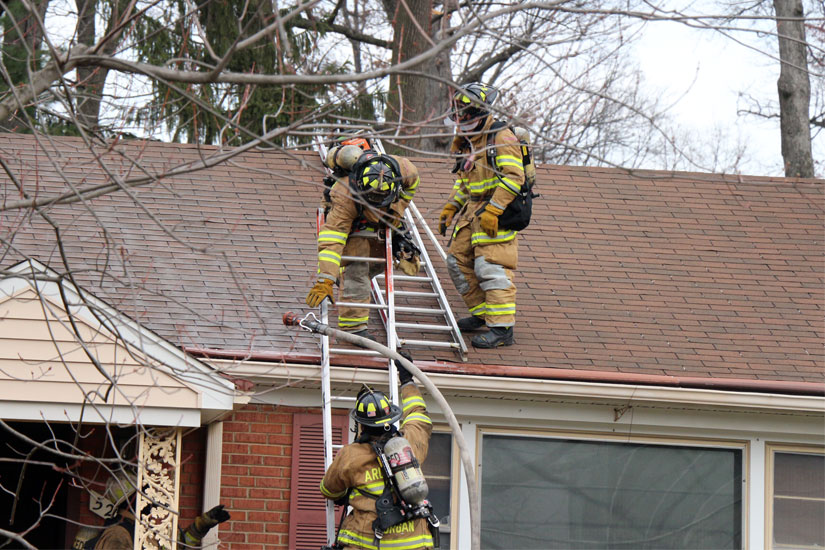
House fire across from  Yorktown High School (Updated at 5:20 p.m.) Arlington County firefighters are asking the county government to fund two additional firefighter positions to service the county’s growing population.

This morning, the Arlington Professional Firefighters and Paramedics Association (the IAFF Local 2800) issued a long, detailed statement on the need to staff Tower 104, which serves the Rosslyn- Ballston corridor, and Rescue 109, which serves Pentagon City and Columbia Pike, with four firefighters, as opposed to their current three-person staffs.

“Tower 104 and Rescue 109, with an ever-rising response area population, massive increase in high-rise square footage, terrorism threat, and other changing factors, require adequate staffing to safely and effectively carry out our assignments,” the Local 2800 writes. “The current staffing of three firefighters is woefully and dangerously inadequate.”

Rescue 109 was one of the first responders to the house fire in Nauck on March 15 that claimed two lives, and the firefighter who was injured fighting the blaze was on the three-person truck. He has not yet returned to duty, according to the Local 2800.

Tower 104 is a large fire truck with a ladder and “bucket” that puts firefighters into position, while Rescue 109 is a truck with no ladder that transports firefighters to emergency scenes, but comes equipped with tools for responding to car accidents and building collapses, according to Arlington County Fire Chief James Schwartz. Both trucks are staffed with firefighter/EMTs.

Schwartz said he has been advocating for four-person units for years, but he said budget constraints have prevented Tower 104 and Rescue 109 from joining the rest of the county’s fleet with four-person staffs.

“It’s been a longstanding position of mine and it has been advocated by the department for some time,” Schwartz told ARLnow.com this afternoon. “Obviously, the Board has to make policy decisions. I think they, too, would like to get to four-person staffing in each of the units. Sometimes the budget guidance is limiting in that regard.”

Schwartz said four-person staffing is not as simple as just hiring two more firefighters. Each additional firefighter on a truck is the equivalent of four full-time positions, to account for three eight-hour shifts a day and covering for vacation and sick leave.

“In order to achieve the safe staffing levels that we’re after, it would require us to hire eight new positions,” he said. “That’s not an insignificant budget issue. It’s doable, and I think the Board is supportive of this effort.”

Arlington County fire truck

Schwartz said years ago, only about half of Arlington’s fire trucks were manned by four-person crews, but the last time the county added staff to bring fire trucks up to four-person teams was in 2004.

Four-person trucks are not just the ideal position for the union, Schwartz said, but it’s also the national standard as dictated by the National Fire Protection Association and several other advocacy groups. Despite the fact that Tower 104 and Rescue 109 are assigned to some of the county’s most densely populated areas, the decision to leave specifically those two units undermanned was done after careful risk analysis.

“Almost every unit in the department is quite busy and has a level of responsibility that is not greater or lesser than any other unit in the system,” he said. “We have 14 suppression units in service every day. Twelve have four-person staffing, and those were selected based on judgments we make that have a lot to do with call activity, the kind of calls that units run. I have to make judgments based on the resources I’ve been allocated.”

Schwartz said the County Board gave County Manager Barbara Donnellan direction to “review all public safety staffing and to make a recommendation for FY 2016,” at a budget meeting last month. To the Local 2800, FY 2016 is already too late.

“It has been shown that increased staffing reduces firefighter injuries, thus reducing the amount of money paid by Arlington taxpayers to care for and backfill with overtime employees,” the union writes. “Tower 104 and Rescue109 are limited in being able to safely, quickly, and effectively perform… critical functions while understaffed with three firefighters… This is dangerous and unacceptable.”

File photos

Don’t Settle for Student Loans to Pay for Online Education

Online college programs are becoming a more popular choice for prospective students, with one study finding that more than 6 million students enrolled in at least one online course in fall 2015. The popularity of these courses can be attributed in part to their flexibility with working adults' schedules, students' ability to progress more quickly through online programs and, oftentimes, cheaper tuition. [See 10 low-cost online bachelor's programs for out-of-state students.]Online degrees can be beneficial to many college students, but some studies have shown online learners complete their programs at lower rates than students at traditional brick-and-mortar campuses. Individuals with student loans but no degree comprise two-thirds of defaulted borrowers. Though these numbers are not encouraging, just like for traditional programs, there are ways to reduce how much you'll need to borrow for an online program to ensure you won't become one of these statistics. Don't just settle on borrowing student loans to cover the whole cost of your program and living expenses. Instead, start thinking about how to cut costs and cover your balance in different ways, such as the following. -- Grants and scholarships: Even though you are taking an online course, you can still apply and receive grants and scholarships. But your first step should be to complete the Free Application for Federal Student Aid, commonly referred to as the FAFSA, which will allow you to receive a Pell Grant if your expected family contribution is low enough. The EFC criteria and award amounts are adjusted annually, but the 2017-2018 academic year awards range from $606 to $5,920, which could significantly lower the amount you borrow annually. Your next step is to apply for scholarships. You can start by checking online scholarship search engines, such as the Salt Scholarship Search, College Board's BigFuture and Peterson's. But don't forget to take advantage of local organizations and your school's financial aid office. Both may offer scholarships that you can't find with a national scholarship search. [Review these 10 sites to kick off your scholarship search.]For instance, organizations like the Elks Club, Knights of Columbus or the Rotary Club typically offer scholarships annually to local students. Just because you're going to school online doesn't mean you're ineligible. Visit your local library for scholarship listings, and ask around town. You might be surprised how many local organizations offer scholarships. While these scholarships typically aren't large, every little bit counts. Each dollar you receive in a scholarship is a dollar you don't have to borrow and pay interest on. -- Work-study: Another option for online students may be work-study awards. Not all students enrolled in online programs are eligible, but students at some schools -- including, for example, SUNY Empire State College and Liberty University -- are. Work-study awards are not given upfront like scholarships and grants. In most cases, they are an offer to earn up to the awarded amount if you secure an eligible work-study job. While there is a misconception that all work-study jobs must be on campus, students can work for off-campus, nonprofit or public employers as long as the work is in the public's interest. You may be able to work for a for-profit employer if the job is relevant to your course of study. No matter who the outside employer is, it will need to have an established agreement with your college for you to receive work-study funds. Remember, to be eligible for federal financial aid, you must be enrolled and pursuing a degree or certificate. If you're not working toward a credential, Pell Grants and work-study won't be option, but you may still be able to take advantage of private scholarships -- just be sure to read the eligibility criteria carefully. [Explore what to know about financial aid in online programs.]-- Pay as you go: One of the great benefits to enrolling online is the flexible schedule, which can allow you to complete your college coursework around your responsibilities. But prospective students often overlook using their part- or full-time job earnings as an option for paying for college. Almost 80 percent of college students in 2015 worked at least part time while attending classes, according to the National Center for Education Statistics. By budgeting and thinking strategically about your college costs, you can likely reduce your dependence on student loans by paying a portion out of pocket. Many -- but not all -- online programs are less expensive than traditional programs and often have shorter payment periods. Six, eight or 10 weeks are common course durations. Because of the frequency of payments in an online setting, you may be well-placed to pay as you go and possibly avoid borrowing altogether. Attending college online and avoiding student loans may be challenging, but if you are willing to put in the effort, you can limit the amount you need to borrow. More from U.S. News Q&A: Understanding Student Loan Discharge Eligibility Student Loan Refinancing Isn't Right for All Borrowers
Read Next Story