
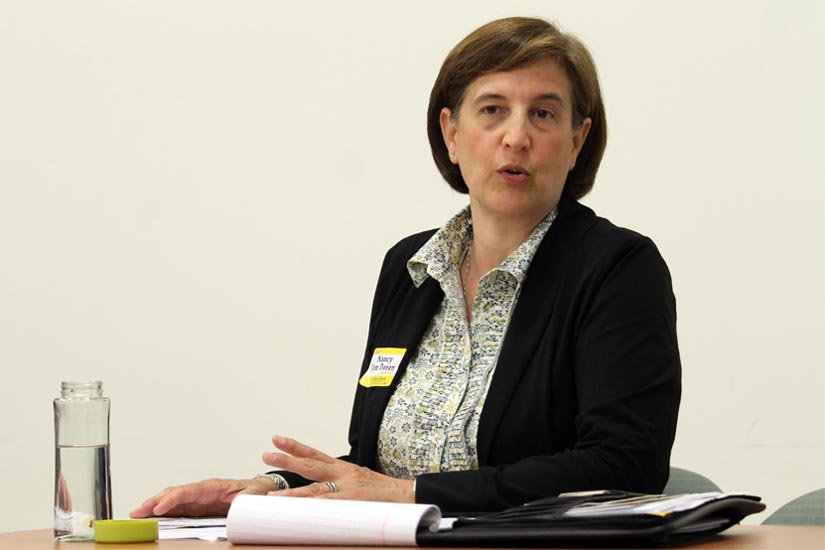
Candidate Essay: Nancy Van Doren

Nancy Van Doren in the 4/22/14 School Board debateLast week we asked the three Arlington School Board candidates who are seeking the Democratic endorsement to write a sub-750 word essay on why our readers should vote for them in the endorsement caucus on May 15 and 17.

Here is the unedited response from Nancy Van Doren:

Arlington Public Schools are at a critical juncture: We must continue to improve educational outcomes for all our students while also finding space for over 700 new students each year. This challenge requires a leader who has a deep understanding of our students and schools. I am that leader. I ask for your support and vote on May 15 and 17 at the Democratic School Board endorsement caucus.

For the last decade I have dedicated myself to working with scores of parents, students, and teachers across Arlington to ensure APS is responsive to individual student needs. I am the only candidate with such extensive experience at the operational level in our schools. I am also the only candidate with hands-on experience at the school and system level in multiple areas, including facilities improvement, transportation, instruction, special education, family engagement and diversity. I am also fluent in Spanish and helped to found the Arlington Latino Network. This experience and knowledge is essential to ensure student, parent and teacher voices are heard at the Board table while critical decisions are made related to facilities and student achievement.

I work collaboratively and build coalitions to fix problems and find solutions. This track record of “getting the job done” is my hallmark. For example, as Jefferson Middle School PTA President, I worked with civic associations, feeder schools, parents, and staff to get Jefferson and its playing fields renovated cost-effectively; I also ensured families from all backgrounds were supported and welcomed in school. I lead the effort and successfully secured Jefferson’s designation as a County-wide school, which enables students from across Arlington to attend the school and receive bus service.

When APS disrupted its transportation system, I stepped up, served on the Multi-Modal Transportation Committee, and worked to issue recommendations to get students safely to school. I lead the successful effort to obtain school bus service to dozens of students along the Columbia Pike Corridor attending Kenmore and Jefferson Middle Schools.

As Chair of the Arlington Special Education Advisory Committee, I spearheaded an effort to have special needs services evaluated, resulting in a blueprint for improved services and instruction. I also created support groups for families and advocated on their behalf, ensuring students got what they needed to succeed in school.
These concrete accomplishments in leadership positions over the past ten years at the school and county level set me apart from the other candidates.

I am education advocate with extensive business and international experience. I spent 12 years in the private sector with Connecticut National Bank, The Travelers Companies, The Hartford Courant and Newsday. I am fluent in Spanish and lived in Nicaragua and Spain. I spent eight years overseas with my husband Jack Zetkulic, a Foreign Service Officer, and my family living in Serbia, Sweden and Switzerland. For the last decade, my family and I have lived in Ashton Heights and my children attend Jefferson Middle School and W-L High School). I served on and/or Chaired the following Committees in APS: Multi-Modal Student Safety Special Services Committee, Arlington Career Center Parent Advisory Committee, Family and Community Engagement Working Group, Arlington Special Education Advisory Committee, ADHD Task Force, Advisory Council on Instruction, County Council of PTAs, Jefferson Middle School PTA President, Washington-Lee Crew Boosters and Fundraising, Arlington Latino Network (Founding Member), ArlingtonADHD and ArlingtonReading Parent Support Groups (Founder).

To read more about my candidacy, please visit my website www.nancyvandoren.org. I can also be found on Facebook at Nancy Van Doren for School Board.

Don’t Settle for Student Loans to Pay for Online Education

Online college programs are becoming a more popular choice for prospective students, with one study finding that more than 6 million students enrolled in at least one online course in fall 2015. The popularity of these courses can be attributed in part to their flexibility with working adults' schedules, students' ability to progress more quickly through online programs and, oftentimes, cheaper tuition. [See 10 low-cost online bachelor's programs for out-of-state students.]Online degrees can be beneficial to many college students, but some studies have shown online learners complete their programs at lower rates than students at traditional brick-and-mortar campuses. Individuals with student loans but no degree comprise two-thirds of defaulted borrowers. Though these numbers are not encouraging, just like for traditional programs, there are ways to reduce how much you'll need to borrow for an online program to ensure you won't become one of these statistics. Don't just settle on borrowing student loans to cover the whole cost of your program and living expenses. Instead, start thinking about how to cut costs and cover your balance in different ways, such as the following. -- Grants and scholarships: Even though you are taking an online course, you can still apply and receive grants and scholarships. But your first step should be to complete the Free Application for Federal Student Aid, commonly referred to as the FAFSA, which will allow you to receive a Pell Grant if your expected family contribution is low enough. The EFC criteria and award amounts are adjusted annually, but the 2017-2018 academic year awards range from $606 to $5,920, which could significantly lower the amount you borrow annually. Your next step is to apply for scholarships. You can start by checking online scholarship search engines, such as the Salt Scholarship Search, College Board's BigFuture and Peterson's. But don't forget to take advantage of local organizations and your school's financial aid office. Both may offer scholarships that you can't find with a national scholarship search. [Review these 10 sites to kick off your scholarship search.]For instance, organizations like the Elks Club, Knights of Columbus or the Rotary Club typically offer scholarships annually to local students. Just because you're going to school online doesn't mean you're ineligible. Visit your local library for scholarship listings, and ask around town. You might be surprised how many local organizations offer scholarships. While these scholarships typically aren't large, every little bit counts. Each dollar you receive in a scholarship is a dollar you don't have to borrow and pay interest on. -- Work-study: Another option for online students may be work-study awards. Not all students enrolled in online programs are eligible, but students at some schools -- including, for example, SUNY Empire State College and Liberty University -- are. Work-study awards are not given upfront like scholarships and grants. In most cases, they are an offer to earn up to the awarded amount if you secure an eligible work-study job. While there is a misconception that all work-study jobs must be on campus, students can work for off-campus, nonprofit or public employers as long as the work is in the public's interest. You may be able to work for a for-profit employer if the job is relevant to your course of study. No matter who the outside employer is, it will need to have an established agreement with your college for you to receive work-study funds. Remember, to be eligible for federal financial aid, you must be enrolled and pursuing a degree or certificate. If you're not working toward a credential, Pell Grants and work-study won't be option, but you may still be able to take advantage of private scholarships -- just be sure to read the eligibility criteria carefully. [Explore what to know about financial aid in online programs.]-- Pay as you go: One of the great benefits to enrolling online is the flexible schedule, which can allow you to complete your college coursework around your responsibilities. But prospective students often overlook using their part- or full-time job earnings as an option for paying for college. Almost 80 percent of college students in 2015 worked at least part time while attending classes, according to the National Center for Education Statistics. By budgeting and thinking strategically about your college costs, you can likely reduce your dependence on student loans by paying a portion out of pocket. Many -- but not all -- online programs are less expensive than traditional programs and often have shorter payment periods. Six, eight or 10 weeks are common course durations. Because of the frequency of payments in an online setting, you may be well-placed to pay as you go and possibly avoid borrowing altogether. Attending college online and avoiding student loans may be challenging, but if you are willing to put in the effort, you can limit the amount you need to borrow. More from U.S. News Q&A: Understanding Student Loan Discharge Eligibility Student Loan Refinancing Isn't Right for All Borrowers
Read Next Story