
Candidate Essay: Greg Greeley

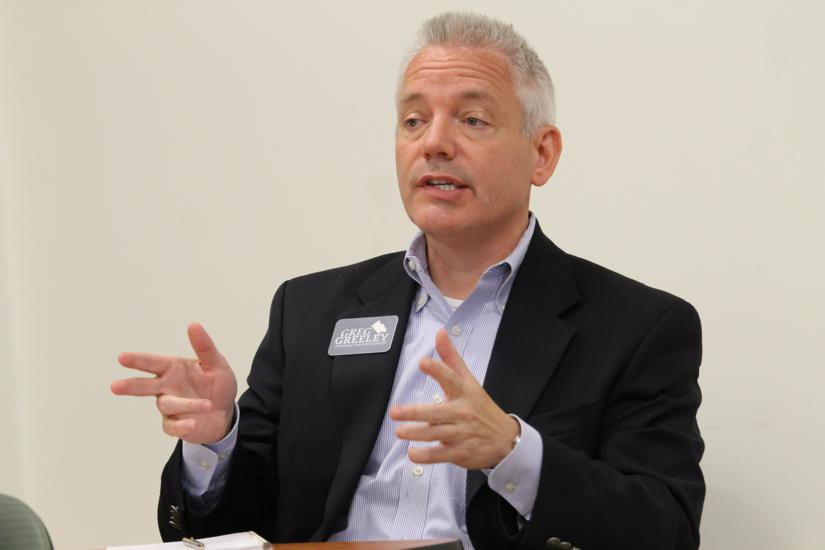
Greg Greeley in the 4/22/14 School Board debateLast week we asked the three Arlington School Board candidates who are seeking the Democratic endorsement to write a sub-750 word essay on why our readers should vote for them in the endorsement caucus on May 15 and 17.

Here is the unedited response from Greg Greeley:

Over coffees and breakfasts, and outside the more than 1,000 doors I’ve knocked on since December, I’ve had great conversations about how to make our good schools even better.  It’s been a chance to listen and learn and to share my own vision for our schools.

I’m so grateful to have earned the support of Sally Baird, Karen Darner, Ingrid Morroy, Patrick Hope, Adam Ebbin and so many other community leaders.  The Gay & Lesbian Victory Fund and Past PTA Presidents from across Arlington have endorsed me, as have even the Wakefield High School Young Democrats.  Now I’m asking you for your support.  I hope you will agree that I am the best choice to serve on the Arlington School Board right now.

Why should you vote for me?  Here are four reasons:

I’m the only candidate who lives in South Arlington.  A 27-year resident of Columbia Pike, my son attended Randolph Elementary School, a Title 1 school that has struggled to meet the needs of its diverse learners.  There I worked closely with families, staff, school administration, and neighbors to build a stronger neighborhood school.  My son now attends Jefferson Middle School and will attend Wakefield High School.  With a perspective shaped by my experience in South Arlington schools, I will bring a critical balance to the School Board.   I will work to meet the needs of all school communities.

I’m the only candidate working on our school system’s crowding problem.  As a member of the Arlington Public Schools (APS) Facilities Advisory Council (FAC) and chair of its Projections and Capacity Subcommittee, I have been immersed in the most critical issue facing our school system–our capacity crisis.  Over 7,000 additional students will enter APS in the next decade.  I am already working to ensure that APS provides sufficient resources to meet the needs of all our children in the best way possible.  I am also working to ensure that our solutions are constructive and positive, serving the needs of all students.  The School Board named me an “Honored Citizen” for my service to our public schools on this important issue.

I am the only candidate with more than 25 years of professional leadership experience.  An Air Force veteran and business professional, I have managed budgets and staff and know how to address our community’s needs in fiscally responsible ways.  Working with the County Board (which funds our schools), I will guarantee that we plan smartly, use our resources wisely, and ensure our school system’s current and future needs are met.

Finally, I am the only candidate who is the parent of an English language learner.  As a foster parent and the parent of an English language learner who is now a Dream Project scholar, I know we can do better for our kids with special needs.  We must serve all of our children with special needs, be they students with language and ability needs or students with gifted needs.  I will work to ensure that all of our learners with special needs get the early intervention and consistent, effective support they need to succeed in school and in life.

To learn more, please visit my campaign web site at www.gregreeley.com.  Thank you for your support on May 15th or 17th!

Don’t Settle for Student Loans to Pay for Online Education

Online college programs are becoming a more popular choice for prospective students, with one study finding that more than 6 million students enrolled in at least one online course in fall 2015. The popularity of these courses can be attributed in part to their flexibility with working adults' schedules, students' ability to progress more quickly through online programs and, oftentimes, cheaper tuition. [See 10 low-cost online bachelor's programs for out-of-state students.]Online degrees can be beneficial to many college students, but some studies have shown online learners complete their programs at lower rates than students at traditional brick-and-mortar campuses. Individuals with student loans but no degree comprise two-thirds of defaulted borrowers. Though these numbers are not encouraging, just like for traditional programs, there are ways to reduce how much you'll need to borrow for an online program to ensure you won't become one of these statistics. Don't just settle on borrowing student loans to cover the whole cost of your program and living expenses. Instead, start thinking about how to cut costs and cover your balance in different ways, such as the following. -- Grants and scholarships: Even though you are taking an online course, you can still apply and receive grants and scholarships. But your first step should be to complete the Free Application for Federal Student Aid, commonly referred to as the FAFSA, which will allow you to receive a Pell Grant if your expected family contribution is low enough. The EFC criteria and award amounts are adjusted annually, but the 2017-2018 academic year awards range from $606 to $5,920, which could significantly lower the amount you borrow annually. Your next step is to apply for scholarships. You can start by checking online scholarship search engines, such as the Salt Scholarship Search, College Board's BigFuture and Peterson's. But don't forget to take advantage of local organizations and your school's financial aid office. Both may offer scholarships that you can't find with a national scholarship search. [Review these 10 sites to kick off your scholarship search.]For instance, organizations like the Elks Club, Knights of Columbus or the Rotary Club typically offer scholarships annually to local students. Just because you're going to school online doesn't mean you're ineligible. Visit your local library for scholarship listings, and ask around town. You might be surprised how many local organizations offer scholarships. While these scholarships typically aren't large, every little bit counts. Each dollar you receive in a scholarship is a dollar you don't have to borrow and pay interest on. -- Work-study: Another option for online students may be work-study awards. Not all students enrolled in online programs are eligible, but students at some schools -- including, for example, SUNY Empire State College and Liberty University -- are. Work-study awards are not given upfront like scholarships and grants. In most cases, they are an offer to earn up to the awarded amount if you secure an eligible work-study job. While there is a misconception that all work-study jobs must be on campus, students can work for off-campus, nonprofit or public employers as long as the work is in the public's interest. You may be able to work for a for-profit employer if the job is relevant to your course of study. No matter who the outside employer is, it will need to have an established agreement with your college for you to receive work-study funds. Remember, to be eligible for federal financial aid, you must be enrolled and pursuing a degree or certificate. If you're not working toward a credential, Pell Grants and work-study won't be option, but you may still be able to take advantage of private scholarships -- just be sure to read the eligibility criteria carefully. [Explore what to know about financial aid in online programs.]-- Pay as you go: One of the great benefits to enrolling online is the flexible schedule, which can allow you to complete your college coursework around your responsibilities. But prospective students often overlook using their part- or full-time job earnings as an option for paying for college. Almost 80 percent of college students in 2015 worked at least part time while attending classes, according to the National Center for Education Statistics. By budgeting and thinking strategically about your college costs, you can likely reduce your dependence on student loans by paying a portion out of pocket. Many -- but not all -- online programs are less expensive than traditional programs and often have shorter payment periods. Six, eight or 10 weeks are common course durations. Because of the frequency of payments in an online setting, you may be well-placed to pay as you go and possibly avoid borrowing altogether. Attending college online and avoiding student loans may be challenging, but if you are willing to put in the effort, you can limit the amount you need to borrow. More from U.S. News Q&A: Understanding Student Loan Discharge Eligibility Student Loan Refinancing Isn't Right for All Borrowers
Read Next Story