
The email listserv of the Clarendon-Courthouse Civic Association (CCCA) erupted today in protest over changes to Arlington’s noise ordinance, which the County Board is scheduled to vote on tomorrow (Saturday).
The changes are needed in order to allow police to objectively enforce the noise ordinance; the current ordinance contains subjective enforcement provisions that were struck down by the state Supreme Court. The ordinance attempts to address what county officials say are the top four noise-related complaints in Arlington: loud parties or gatherings, construction noise, animal noises and live entertainment venues.
Business advocates have said that an overly-restrictive noise ordinance could chase away younger residents and discourage local economic development. The new ordinance, county staff says, attempts to find a balance between resident concerns and business needs.
CCCA leaders, however, say that the provisions don’t adequately protect residents in the county’s urban corridors — so-called “mixed use districts” — against noise from parties and outdoor restaurant patios. While for residential neighborhoods the ordinance outlaws “yelling, wailing, shouting or screaming” that’s audible anywhere within 50 feet of the noise source after 9:00 p.m. (10:00 p.m. on weekends), for mixed use districts the noise must be audible indoors, from 100 feet away, after midnight.
“Clarendon is a vibrant mixed use and walkable community and as a neighborhood we generally expect a certain amount of noise related to the restaurants and traffic after those hours,” CCCA President Adam Thocher told ARLnow.com. “However the idea that continued smart growth of our neighborhood is dependent on little to no protection from noise 24/7 is incredible… The CCCA regularly receives feedback on how increasingly loud the outdoor patio space at neighboring restaurants is becoming.”
Even so, Thocher said he was particularly concerned about noise from “keg parties,” which are subject to the same standards as restaurants.
“The idea that the noise from a neighbor’s raucous parties are held to the same noise standards as the restaurant patio is unacceptable even in a mixed use area,” he said.
A former CCCA president, Chris Keever, also weighed in on the issue today, writing the County Board a letter that accused the county of appeasing restaurant owners at the expense of residents of Arlington’s Metro corridors.
“This proposal would leave an overwhelming number of residents of this neighborhood with zero recourse to enforce quiet enjoyment of their own properties,” Keever wrote. “It appears to me to have been drafted directly by bar owners who are not even trying to pretend they care about being good neighbors. It is the right of business owners to make a profit, but not for them to make outrageous profit at the expense of the majority. This is Arlington, not Wall Street.”
The full letters from Thocher and Keever, after the jump.
CCCA President Adam Thocher’s letter to civic association members:
Neighbors,
I am writing to alert you to consider contacting the Arlington County Board immediately to let them know you want to be included among those residents who will get strong protection from late night “keg party” and similar noise. If you don’t, there is a chance you might no longer be able to get any help from the police from a noisy outdoor party that goes on well after midnight. The Board takes their final votes on Saturday.
The Arlington County Board will be considering for final adoption proposed changes to the noise ordinance. There is a lengthy staff report that describes the reasons for the changes and what they entail. That report can be found at this link: http://arlington.granicus.com/MetaViewer.php?view_id=2&event_id=707&meta_id=121010
The revised noise ordinance is going to rely much less on the use of noise meters and much more on other kinds of standards. But there is one aspect of these changes you need to be aware of because it directly affects our rights as people who live in high-density areas.
The specific issue of contention is what might be thought of as the “keg party” rule. This is the part of the ordinance that protects neighbors late at night from “yelling, wailing, shouting or screaming” in a group of four or more persons that can be heard at a distance and/or inside someone else’s home. The proposed ordinance would only protect some homes from this noise, and would leave many Clarendon residents with little or no protection from an all-night party with people screaming and shouting from a neighboring balcony or rooftop.
The County Board could not decide at its last meeting whether or how much to protect most of the people who live in our neighborhood from such noise. There is a potential that the vast majority of us who live in the CCCA could lose the ability to get help from the police even if we are being kept awake at 1 a.m. from such screaming and shouting.
The situation is somewhat complicated, but what it boils down to is that the County staff have suggested dividing the County into three areas with respect to such noise: the “haves”, the “have less” and the “have nots”. There are also differing proposals as to what level of protection each of these categories might get. I will try to briefly outline these:
The “haves” (those who live in “R” zones and four specific types of “RA” zones)
- protected from “keg party” noise after 9 p.m. until 7 a.m. weeknights and 10 p.m. to 9 a.m. weekends.
- protected from “keg party” noise that can be heard more than 50 feet away *outside*
- protected from “keg party” noise that can be heard inside your home more than 20 feet from the party.
The “have less” (those who live in “Mixed Use” zones, which has an unclear definition)
- protected from “keg party” noise only after midnight
- protected from “keg party” noise only if it can be heard more than 100 feet from the party from inside your home
- not protected from “keg party” noise that can only be heard outdoors
- not protected from “keg party” noise if you are less than 100 feet from the party
The “have none” (those that don’t live in either of the above two categories)
- protected from “keg party” noise only between 2 a.m. and 6 a.m.
- protected from “keg party” noise only if it can be heard inside your home.
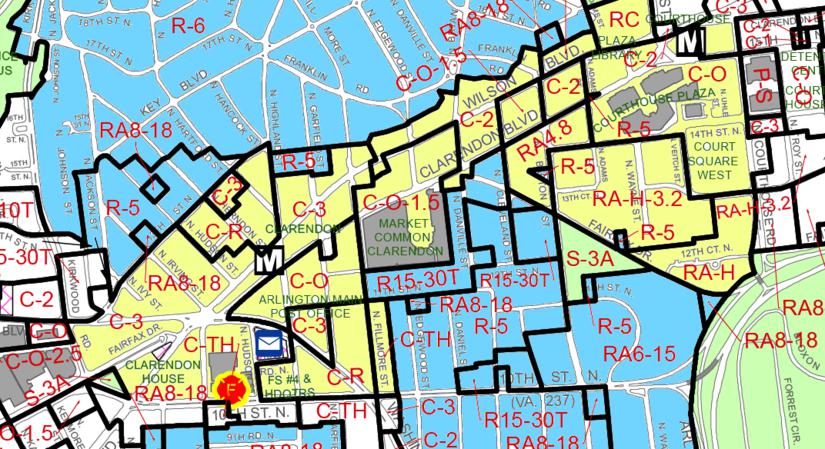
Please see the attached map to see who in our neighborhood lives where. I gave this map special colors so you can see what is proposed. People who live in the blue-colored areas are in the “haves”. People who live in the yellow-colored areas are EITHER in the “have less” or ”have none” depending on which definition of “mixed use” the County Board adopts.
There are several possible definitions under consideration, but the current staff proposal is to define the “have less” mixed use areas this way: ” ‘Mixed-Use District’ shall mean any area of the County that is developed with a mixture of commercial, retails [sic] and residential uses, whether in the same building or not.”
As you can see from the map IT IS NOT AT ALL CLEAR whether the police or the courts will consider all the places in the yellow areas (like the Williamsburg Condominium) to be “mixed use” because there are no retail or commercial uses within a few blocks from their building. If any of the yellow areas are not defined as “mixed use”, they would only get the 2 a.m. protection from “keg parties”.
Furthermore, there is an organized effort by some in the restaurant industry to roll back even the modest protections described above. This is because the “keg party” rule is drafted to be the SAME rule that will protect residents against noise from outdoor restaurant patios and rooftops. These Clarendon restaurant owners are already meeting with County Board members to try to roll back what staff have put on the table, outlined above. We can expect the restaurant owners to show up at the County Board meeting to argue that their businesses need to be allowed to keep up the outdoor screaming even after midnight. They may also argue for a definition of “mixed use” that specifically excludes some of central Clarendon, such as Lyon Place or 1021 or Station Square, and puts them into the “have none” category of noise protection. (Those whose homes border parks should also be aware that this is the section is also the same one that would protect people from screaming and yelling after hours in a park.)
You should be aware that since the “keg party” screaming and yelling rule is proposed to be the SAME rule as the “restaurant patio” screaming and yelling rule, if the restaurants are successful at rolling back or eliminating those protections, then those of us who live in those areas will also have no protection before 2 a.m. from any kind of “screaming and yelling” noise, no matter what the source.
These proposed rules and definitions were announced only on April 22, and the Board vote is THIS coming Saturday, May 10. This is happening very, very fast and now could be your only chance to weigh in.
The most effective way to voice your concern is to show up and speak at the County Board meeting on Saturday. The County Board meets at 2100 Clarendon Boulevard, 3rd floor. This item will likely go first on the agenda, so starting sometime between 8:45 a.m. and 10 a.m. To be allowed to speak (for 3 minutes) you must arrive before they call the item for discussion. Even better, bring 2 or 3 of your building neighbors to come join you. The more people who come, the more likely the Board is to support us.
Other things you can do if you are concerned is to call the County Board at 703-228-3130 and tell them your concerns about late night outdoor “keg party” noise.
Finally, you can also send an e-mail to the County Board at: countyboard@arlingtonva.us
Let the County Board know you want your home (give them your address) to have the highest possible protection from “keg party” noise. If you think your protections from such noise should start earlier in the night than 2 a.m. or midnight, let them know that. If you think you should be protected from hearing screaming and shouting inside your home late at night even if you are less than 100 feet from the party, let them know that. If you think your building should be treated like a “residential” building rather than a “mixed use” building, let them know that.
Wanted to be sure you were all aware of the issues before it is too late.
Chris Keever’s letter to the County Board:
Members of the Board:
I am writing today to express my frustration with the proposed changes to the noise ordinance. I agree that changes are required, but I believe the proposed changes are totally outrageous, and in the wrong direction.
Over the past 20 years, Clarendon has experienced a radical transformation. This transformation was largely fueled by a belief that traditional planning, which involved rigid separation of use, wasn’t always the best answer – even in a suburb like Arlington. It seemed to make sense that people should be able to live, work, and play in walkable neighborhoods, without having to use their cars. This belief was initially codified via not just via running the Orange line under the R-B corridor (a story which we all know and love), but also through our planning documents, which are a community-driven roadmap toward creating that kind of community.
Since the late 90′s much of that vision has been realized. Clarendon is a success story. As a past Clarendon-Courthouse Civic Association President for over 4 years, I like to think I’ve played a small part in it.
However, that vision and success are now in jeopardy. It has come to my attention that a proposal to revise the noise ordinance has been apparently rushed to you for approval with absolutely no community input. It’s been a couple years for me, but this is not the Arlington Way as I remember it.
This proposal would leave an overwhelming number of residents of this neighborhood with zero recourse to enforce quiet enjoyment of their own properties. It appears to me to have been drafted directly by bar owners who are not even trying to pretend they care about being good neighbors. It is the right of business owners to make a profit, but not for them to make outrageous profit at the expense of the majority. This is Arlington, not Wall Street.
There are always challenges in these situations, but I remember at least a desire and willingness among all concerned to find balance. I don’t think we ever got it quite right – but most bar owners at the time at least appeared willing to help, open to ideas, and genuinely wanted to be good neighbors. I have to assume that this current proposal has been pushed a new faction who simply do not care about any of this. Balance and the rights of nearby property owners do not seem to matter in this proposal.
Even back when I was president, there was friction between bar patrons and residents. I had bar patrons urinating on my townhome. People liked to pre-party on my stoop. Sometimes, resentful of my calling police (who never enforced the open container laws), these people returned, threatened and confronted me as if their rights had been violated and I was somehow in the wrong. Some of you on the Board might recall when I spoke before you about these issues – the day after I was assaulted on my own property.
Regarding noise – I called countless times when violations of the *existing* noise ordinance occurred, and never received timely enough service. The police always explained at the neighborhood meetings that they had *real* problems – they had to station themselves directly outside the bars to break up the numerous and almost constant fights that broke out (as we learned from the recent bar crawl experience, bar presence has external costs that are not always borne by bar owners – but should be). Safety had to come first, and rightly so. Unfortunately, these bar meetings (which involved police, County staff, bar owners and residents), never were productive. The real-world result was that they were just a place for residents to vent, but no change was ever effected from them.
Therefore, I posit to you that the existing noise ordinance and other tools available must be *strengthened*. I believe that we as a community ought to take this opportunity to have a real conversation about how that can happen, and how the quality of life for those who live in this success story we call Clarendon can be improved. When I lived in Clarendon, I saw roughly 1000+ condo units (easily assessed at $400K each at the time) added to my street alone within a 1-block radius from my house. I was shocked when it seemed that none of that additional residential tax revenue could be redirected back to the neighborhood to improve these issues for residents. In addition, bar owners have a responsibility and should be contributing to these efforts as well, either directly, or through a portion of their existing tax revenue.
Clarendon is a special place, but to really make it work, it needs to have the right mechanisms in place to ensure quiet enjoyment of our property.
A few ideas:
- Establish a Live Entertainment Commission – like our other Commissions – comprised of residents of impacted neighborhoods. This commission would recommend approval and timelines for live entertainment permit renewals.
- Improve the existing noise ordinance – ensure appropriate response time and enforcement. This would require redirected revenue and a dedicated fund.
- Create a new “live entertainment district” zoned parking restriction Thursday, Friday and Saturday nights from 11pm-7am in front of townhomes and apartment buildings.
- Dedicate additional space for taxi stands (instead of parking spaces) at concentrated bar locations.
- Funding for several police offers dedicated to foot patrol near bar parking areas.
- Additional trash pickup (from the dedicated fund). Some bar owners already do this voluntarily.
- Require a 3 month renewal of live entertainment permits across the board with careful tracking of calls and violations.
- Stop live music at 11:30pm, prevent serving of alcohol after 11:30pm, close the bars at 11:30pm or any combination. THIS WOULD REQUIRE ZERO ADDITIONAL TAX REVENUE – and would solve a substantial amount of the issue. Arlington is a suburb, not a city.
I have always believed that the balance we’ve all sought in the past is within our grasp. As current Board members, you are stewards of Clarendon’s successful legacy. The current proposal is completely outrageous, and would do irreparable harm to this legacy.
We are on the right path, but instead of approving this monstrosity, I urge you to instead build on our successful legacy. We must strengthen the tools available to improve quality of life for residents – not just for those who want to singularly profit from Clarendon’s success. Now is the time for us to have that conversation as a community.
Respectfully,
Chris Keever