
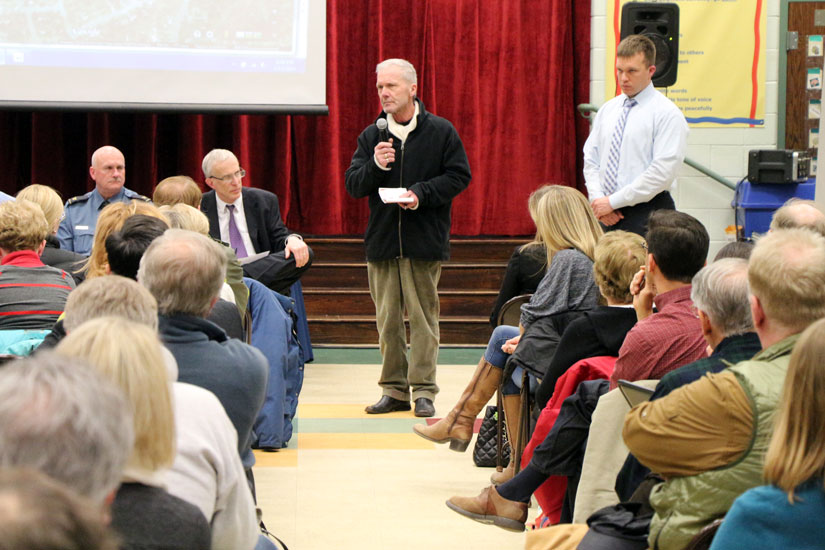
 About 100 residents packed the auditorium at Nottingham Elementary School last night, less than three weeks after a mother placing a child in her minivan was killed by a dump truck in front of the school.
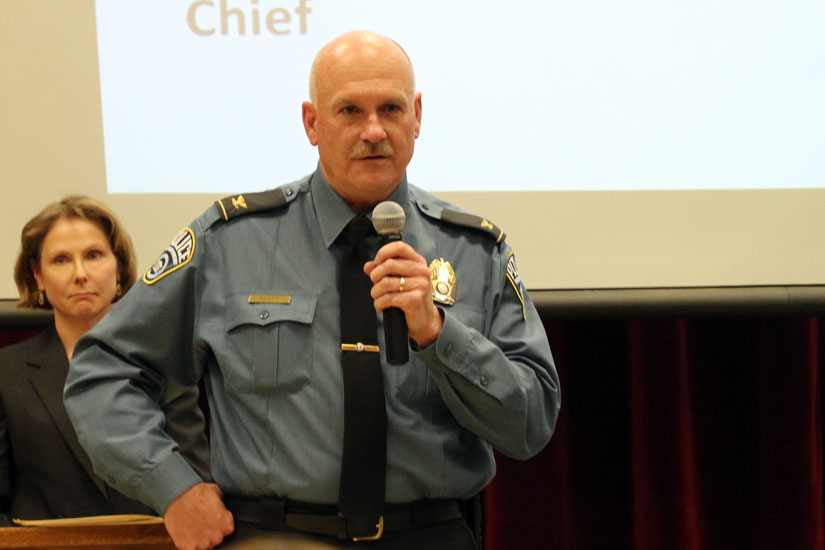
Arlington County Police Chief Doug Scott gave members of the Williamsburg Civic Association updates on the investigation into the death of 39-year-old Jennifer Lawson, and he took questions from more than 20 residents, most of whom demanded action to increase pedestrian safety in the area.
Scott said the driver of the truck was neither speeding nor distracted when his vehicle struck Lawson’s minivan.
“The driver has been very cooperative with the investigation,” Scott said. “We’ve done a forensic exam of his cell phone and that was not an issue… This was not a cut-through traffic situation. This gentleman was doing contract work in your neighborhood. He had been in and out of the neighborhood a couple of times that day.”
 Scott said the truck’s body didn’t strike the van’s door, it was the side footstep to the passenger’s seat.
“It was a matter of inches,” he said.
Speakers said the police presence in the area for a few days after the collision has since disappeared, leading many to criticize the police’s presence along Lee Highway nearby, where cars are frequently stationed for hours. Scott said that squad cars are placed where there are the most complaints, but even if they were in the residential neighborhood, “a majority of the tickets we write are to people who live in those communities.”
Julie Monticello, a mother of six who lives on N. Ohio Street across from the school, said members of the community have to also look inward after the accident.
“I couldn’t sleep that night not only because of Jen, but also because of that dump truck driver, because it could have been any of us,” she said, while fighting back tears. “I know that’s so hard to say. That man is not a murderer, everyone should say a prayer for that man, because he’s not a murderer.”
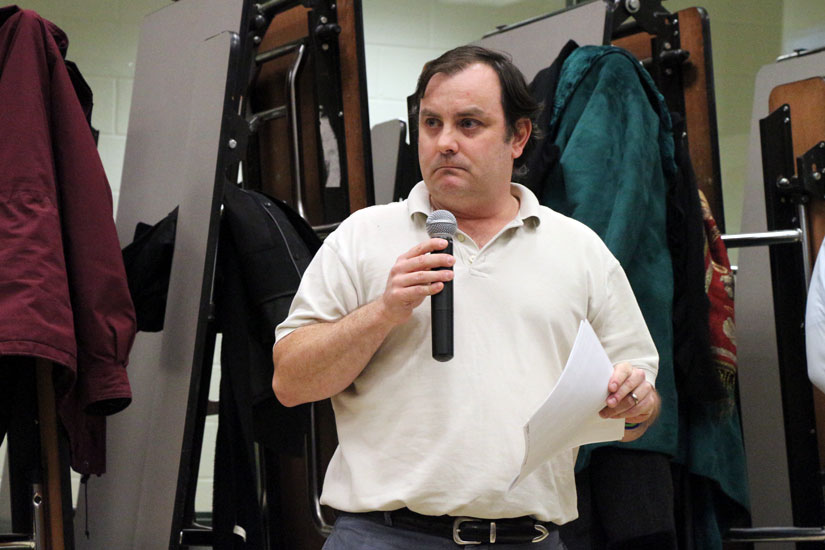 Monticello was not the only person to get emotional while speaking on the microphone. Richard Sheehey, who lives on N. Kensington Street, choked up several times during his plea for speed bumps and a lower speed limit on his street and throughout the neighborhood. There had been a traffic calming committee a few years ago, Sheehey said, but they were one vote from approving changes and the committee has since been disbanded.
“I get very emotional about this,” he said. “I don’t want to see what happened to Jen happen to any one of our kids… Nobody likes speed bumps, but it’s the No. 1 way to slow traffic down. If a car hits a child at 25 mph, that child has a good chance of survival. If a car hits a child at 35 mph, that kid’s going to die. So please help us.”
Del. Patrick Hope (D) was in attendance, and told the civic association that he plans to introduce a bill in the House of Delegates next year that would allow localities to lower their speed limits below the state minimum of 25 mph to 20 mph. A majority of the speakers agreed that even 20 mph was too fast for the streets in the area.
“Fifteen miles-per-hour just tells people that there are people crossing the street,” Monticello said. “When there’s children crossing the street constantly, the speed limit has to be 15. Twenty-five doesn’t send the message.”
 Speakers also expressed frustrations with the Arlington County Board, saying that they’ve been asking for safety improvements for years, even after a child on a bicycle had been struck. County Board Chair Jay Fisette was rumored to be coming to the event, but no Board members were in attendance, and Deputy County Manager Mark Schwartz spoke briefly expressing condolences and promising to listen.
WCA President Ruth Shearer asked at the end of the meeting, getting visibly upset, why the Board has been silent.
“Tell us why the County Board does not support the bill to reduce the speed limits,” Shearer said, directing her gaze at Schwartz. “I have not heard why. Why does the Board not want to execute its own implementation option? We need answers.”
The first speaker from the community — after Shearer, Scott, Schwartz and the county’s new Transportation and Engineering Bureau Chief Larry Marshall spoke — was Susan Silver Levy, a friend of Lawson who said Lawson’s children “play every day in my front yard.”
“I’m even more upset because I’ve been trying to get the county’s attention for years about this intersection,” Silver Levy, a former Nottingham PTA member, said. “Last week there was a three-car, high-speed collision at the intersection. It seems like near-misses are often perceived as victories here as opposed to warnings of what could happen.”
“The traffic control sign on Little Falls Road hasn’t worked for seven months,” she continued. “We boast that Arlington is a gold-level walk-friendly community, but I think we still have a ways to go. Until you’ve walked the streets, you just don’t know them. In the past two weeks, I have often wondered whether a four-way stop sign or speed bumps might have saved my friend’s life. Every afternoon I recommit to do everything I can to make the streets safer. It could have been anybody, even you.”
