
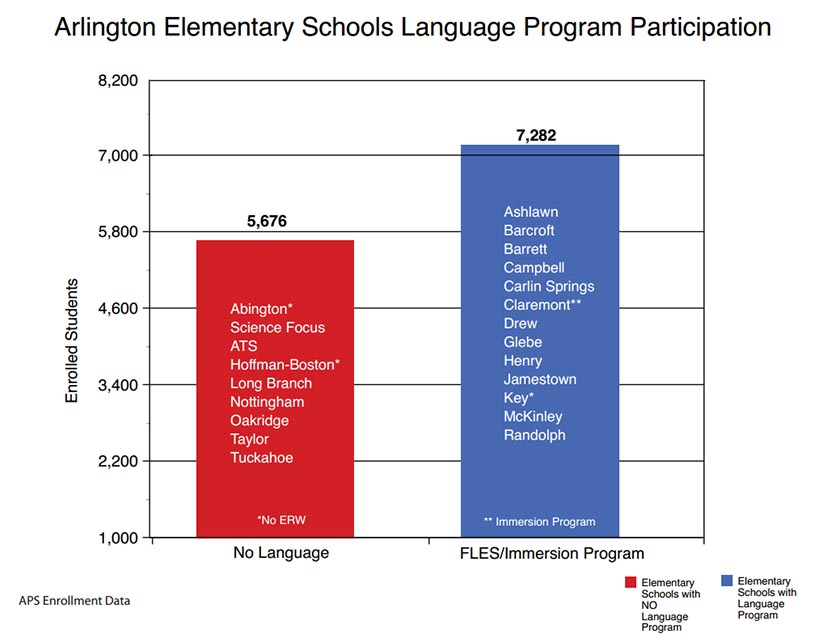
 A vocal group of parents who have been advocating for foreign language education in all Arlington elementary schools once again took their case to the County Board over the weekend.
The Sun Gazette reports that “several dozen” supporters of the Foreign Language in Elementary School (FLES) program showed up for the public comment period of Saturday’s Board meeting. They asked the Board to find a way to work with Arlington Public Schools and the School Board to expand FLES to the 9 schools that currently don’t have the program.
Meanwhile, a group called FLES For All released an open letter to county and school leaders over the weekend. The group, which claims 25-30 active members “who work weekly to educate and advocate on this issue,” blasted “educational inequity” in Arlington and called on the County Board to provide a greater share of tax revenue.
The full letter, after the jump.
Image via FLES For All
Members, Arlington County Board
Members, Arlington County School Board
Dr. Patrick Murphy, Superintendent, Arlington Public Schools
Barbara Donnellan, Arlington County ManagerDear Madams and Sirs:
We are a group of concerned Arlington citizens asking the County and School Boards to provide full school days for 4,700 children in Arlington elementary schools across the county. Partial school days results in a loss of 135 minutes of instructional time each week – almost half a school year of instructional time by the time students enter middle school. We pay the same tax rate and our children do not receive the same education as their peers simply because of the neighborhood in which they live.
Many of us have chosen to live in Arlington because we believed our county to be well managed by our elected leaders and our schools to be among the best in America. We ask that the County Board make education a priority in Arlington again. We respectfully ask the members of the County Board to recognize and acknowledge this inequity by allocating sufficient funds to the School Board to rectify the inequity. We also ask that the School Board refocus its lens on the very basic inequality that it has allowed to continue in the heart of its educational mission – 4,700 (7 schools) elementary school kids who receive less instruction than their peers and 5,476 (9 schools) who are denied access to attain proficiency in a world language at an early age. The responsibility for this inequity lies with the County Board and the School Board collectively. As taxpayers and citizens, it is reasonable to expect that our leaders will work proactively together to tackle the challenges they face in meeting the needs identified by the community they serve. This requires collaborative work on determining funding levels and allotments necessary to address critical gaps in education as that identified here.
The County Board Must Proactively Fund the Basic Needs of Our Schools
We are aware that presently the amount spent per pupil by Arlington Public Schools is among the highest in the country. At the same time, despite major capital projects and significant increase in enrollment the amount spent per pupil from 2008 to 2014 has remained basically flat. The narrow focus on per pupil funding repeatedly cited by the County Board misses the mark. Per pupil funding includes numerous programs that we value as a County and want to maintain: GED, ESOL/HILT, Special Education, teen parenting education, continuing high school education, Pre-K, Montessori, financial aid, and other programs provide specific benefits to specific populations which continue to increase.
The School Board has specifically identified “Increased instructional time for elementary schools with early release Wednesdays” as a key FY14 priority in order to “to ensure that every student is challenged and engaged and to eliminate achievement gaps”. As taxpayers, we believe the ultimate responsibility for ensuring sound fiscal management and stewardship lies with the County Board.
Year over year, the County Board has winnowed away the percentage of tax revenues devoted to our schools, allowing the percentage of the Arlington County Budget spent on our schools to fall from 48.6% to 45.6% in recent years. At the same time, our taxes have increased.
The County Board must work with the School Board to end this inequity by either funding the amount requested by the School Board or publicly explaining why the Count Board believes that the School Board can completely eliminate these inequities by saving specifically identified amounts of school spending currently devoted to other projects.
As documented in numerous studies, great schools drive property values as well as the decision of businesses to locate in our County. The County’s investments in its educational system inure to the benefit of all of its citizens and to the County itself in the form of increased tax revenues going forward.
Arbitrarily linking increased school enrollment needs to a tax increase therefore appears to be a device to avoid planning for the legitimate growth needs of our schools, which the County Board could project on a year over year basis going forward and incorporate in its overall budget. The County Board determined that it will only fund the basic need of increased school enrollment by an increase in taxes: Budget guidance for FY 2014 (adopted on November 17, 2012), requires that “funding to accommodate enrollment above the number of students funded in FY13 shall be addressed through tax revenue increases.” Respectfully, the County Board should consider a review of the “fat” in its own budget before it writes in stone a tax increase.
The County must increase funding to ensure equity in Arlington’s schools and to fund increased enrollment on a proactive basis. We ask that the County Board instruct the County Manager to return to funding Arlington’s schools at a rate of 48.6% – 50% to meet the needs of educating our children.
The School Board Must Address the Educational Inequity
Simply, put, the School Board must review its own budget and fund equal education time to all 22 elementary schools, ending early release Wednesdays. The School Board budget should be consistent with the APS Mission, Vision and Core Values and the APS Strategic Plan applied to ALL APS students, funding implementation for FLES at a minimum of 3-4 schools per year beginning in the 2014 – 2015 school year. To add FLES at 9 schools and eliminate early-release Wednesdays at 7 Schools would require devotion of less than $5 million per year going forward.
We thank you for your consideration and look to be your partners as you advocate for education for our children in Arlington County.
Sincerely,
FLES for ALL Parents & Arlington County Tax Payers
