
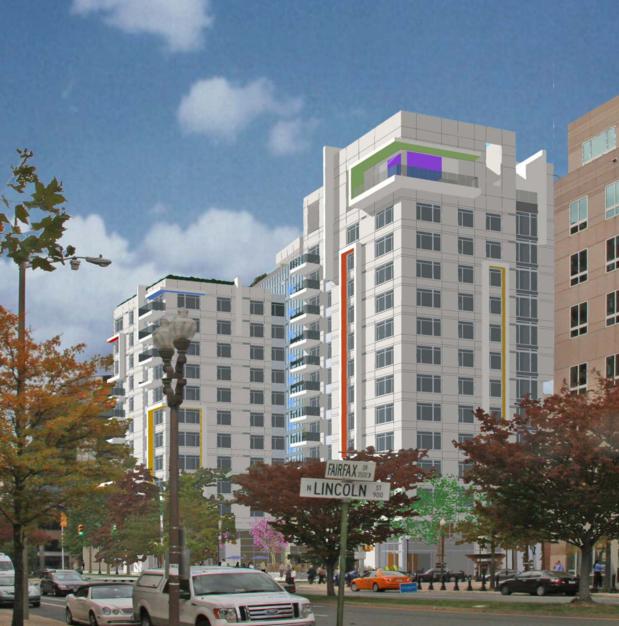
Board Approves New Va. Square Apartments

Latitude Apartments renderingThe Arlington County Board approved a new apartment development in Virginia Square at its Saturday meeting.

The Latitude Apartments will be a 12-story apartment building with 265 residential units and 262 underground parking spaces, on the 3600 block of Fairfax Drive. It will feature a 2,800 square foot “cultural and educational space,” 3,100 square feet of retail space, a public plaza and pedestrian walkway, outdoor seating and a water feature.

Other community benefits include LEED Gold sustainability certification, 14 committed affordable units, a $75,000 public art contribution and funding of utility and transportation improvements.

The project received mixed feedback during the public comment period, with some residents speaking out for it and some against it. Those who opposed it said an office building, not an apartment building, should be built on the site, in keeping with the county’s original land use vision set forth in the 2002 Virginia Square Sector Plan.

Many on the opposition side were residents of nearby condominium buildings, who wore matching badges expressing their opposition. Concerns included added noise, traffic and pedestrian congestion, crowding at the Virginia Square Metro station, visitors parking in residential neighborhoods and other “quality of life issues.”

“My view is that an office building would be the better use,” said resident Anita Wallgren. “I live across the street. By taking action today in a decisive way to deny the applications, you would affirm the sector plan and improve the integrity of the county’s planning process.”

Those supporting the project said the developer, Penrose Group, has been responsive to residents. The development, supporters said, will be a net positive for the neighborhood.

“I love the design of the project from the renderings I’ve seen,” said Judd Ryan, a member of the Ballston-Virginia Square Civic Association. ”Throughout this process I’ve struggled to understand the opposition to this project. The [office] vacancy rate is the highest I’ve seen since living in this market. No developer would build office here without a significant pre-lease.”

County staff spent time refuting claims that the apartment building will have a significant impact on crowding at the Virginia Square station. The station is one of the most under-utilized stations in Arlington, staff said, and the new building will only add about one additional passenger per inbound train during the morning rush hour. In keeping with rates seen at similar apartment buildings, about half of residents will end up driving to work, staff estimated.

The Arlington transportation and planning commissions sided with those opposed to the project, recommending against changing zoning for the site. The Arlington Chamber of Commerce weighed in with a letter, supporting the project and the principals of transit-oriented development. In the end, the Board voted 3-2 for the project, with Chris Zimmerman and Mary Hynes casting the dissenting votes.

Zimmerman said the project is attractive on its own, but that’s not justification enough for “throwing overboard a sector plan.”

“Do we disregard long-term plans because of the appeal of an individual project?” he asked. “That for me is the fundamental problem.”

Jay Fisette stated that he doesn’t “want to send a message that the sector plan isn’t important,” but said the county may have to reexamine its expectations for commercial office development given the current high vacancy rate and market changes like the Silver Line to Tysons and the increasing number of employees who work from home or in co-working environments.

“Conditions in the market are changing,” Fisette said. “Adjustments might be necessary in sector plans.”

Libby Garvey said a sector plan is a guiding document but isn’t dogma.

“The plan is a tool but it’s not something that tells us absolutely what to do,” she said. “Otherwise you wouldn’t need a [County] Board.”

Garvey dismissed concerns about noise — “I assume the people in that building are not going to make any more noise than you all in your building” she said — and crowding at the Virginia Square station — “one of the least-used Metro sites.” She said adding additional housing in the Rosslyn-Ballston corridor will help keep housing costs down.

“One of the reasons housing is so expensive here is because there’s not enough of it, there’s unmet demand,” she said.

Don’t Settle for Student Loans to Pay for Online Education

Online college programs are becoming a more popular choice for prospective students, with one study finding that more than 6 million students enrolled in at least one online course in fall 2015. The popularity of these courses can be attributed in part to their flexibility with working adults' schedules, students' ability to progress more quickly through online programs and, oftentimes, cheaper tuition. [See 10 low-cost online bachelor's programs for out-of-state students.]Online degrees can be beneficial to many college students, but some studies have shown online learners complete their programs at lower rates than students at traditional brick-and-mortar campuses. Individuals with student loans but no degree comprise two-thirds of defaulted borrowers. Though these numbers are not encouraging, just like for traditional programs, there are ways to reduce how much you'll need to borrow for an online program to ensure you won't become one of these statistics. Don't just settle on borrowing student loans to cover the whole cost of your program and living expenses. Instead, start thinking about how to cut costs and cover your balance in different ways, such as the following. -- Grants and scholarships: Even though you are taking an online course, you can still apply and receive grants and scholarships. But your first step should be to complete the Free Application for Federal Student Aid, commonly referred to as the FAFSA, which will allow you to receive a Pell Grant if your expected family contribution is low enough. The EFC criteria and award amounts are adjusted annually, but the 2017-2018 academic year awards range from $606 to $5,920, which could significantly lower the amount you borrow annually. Your next step is to apply for scholarships. You can start by checking online scholarship search engines, such as the Salt Scholarship Search, College Board's BigFuture and Peterson's. But don't forget to take advantage of local organizations and your school's financial aid office. Both may offer scholarships that you can't find with a national scholarship search. [Review these 10 sites to kick off your scholarship search.]For instance, organizations like the Elks Club, Knights of Columbus or the Rotary Club typically offer scholarships annually to local students. Just because you're going to school online doesn't mean you're ineligible. Visit your local library for scholarship listings, and ask around town. You might be surprised how many local organizations offer scholarships. While these scholarships typically aren't large, every little bit counts. Each dollar you receive in a scholarship is a dollar you don't have to borrow and pay interest on. -- Work-study: Another option for online students may be work-study awards. Not all students enrolled in online programs are eligible, but students at some schools -- including, for example, SUNY Empire State College and Liberty University -- are. Work-study awards are not given upfront like scholarships and grants. In most cases, they are an offer to earn up to the awarded amount if you secure an eligible work-study job. While there is a misconception that all work-study jobs must be on campus, students can work for off-campus, nonprofit or public employers as long as the work is in the public's interest. You may be able to work for a for-profit employer if the job is relevant to your course of study. No matter who the outside employer is, it will need to have an established agreement with your college for you to receive work-study funds. Remember, to be eligible for federal financial aid, you must be enrolled and pursuing a degree or certificate. If you're not working toward a credential, Pell Grants and work-study won't be option, but you may still be able to take advantage of private scholarships -- just be sure to read the eligibility criteria carefully. [Explore what to know about financial aid in online programs.]-- Pay as you go: One of the great benefits to enrolling online is the flexible schedule, which can allow you to complete your college coursework around your responsibilities. But prospective students often overlook using their part- or full-time job earnings as an option for paying for college. Almost 80 percent of college students in 2015 worked at least part time while attending classes, according to the National Center for Education Statistics. By budgeting and thinking strategically about your college costs, you can likely reduce your dependence on student loans by paying a portion out of pocket. Many -- but not all -- online programs are less expensive than traditional programs and often have shorter payment periods. Six, eight or 10 weeks are common course durations. Because of the frequency of payments in an online setting, you may be well-placed to pay as you go and possibly avoid borrowing altogether. Attending college online and avoiding student loans may be challenging, but if you are willing to put in the effort, you can limit the amount you need to borrow. More from U.S. News Q&A: Understanding Student Loan Discharge Eligibility Student Loan Refinancing Isn't Right for All Borrowers
Read Next Story