
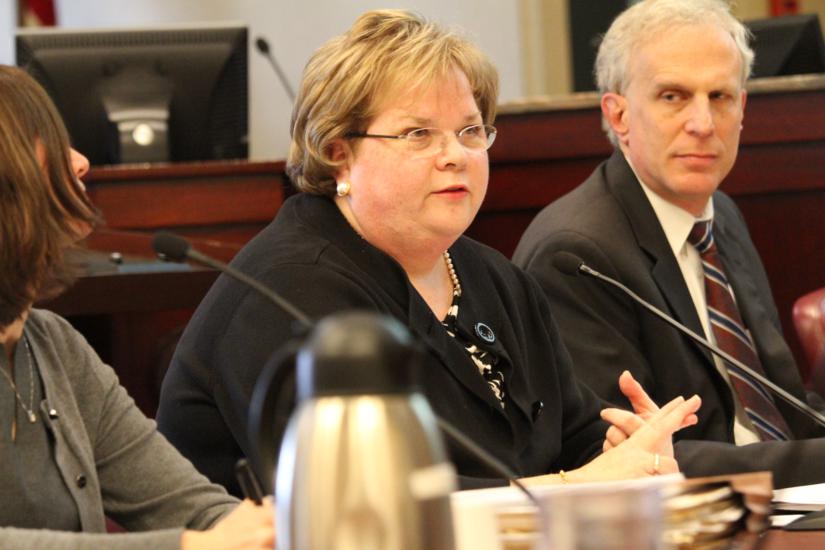
 Arlington County Manager Barbara Donnellan is recommending that the County Board take no action on the hot-button issue of urban hen raising.
At a work session with the Board last night (Tuesday), Donnellan and county staff presented their work thus far on the recommendations of Arlington’s Urban Agriculture Task Force.
While the task force made a total of 27 recommendations on various urban agriculture issues, the issue of whether to allow residents of single family homes to raise egg-laying hens in their backyards has garnered the most public attention. Donnellan told the Board that there are too many “unanswered questions” about hen raising in Arlington County and enforcement of new hen-related ordinances could prove to be a “drain on county resources.”
She recommended that the current county code on poultry — which requires that the poultry owner keep the animals so far from neighboring property lines that only 15 properties qualify countywide — be maintained. Should the Board decide to move forward with a more permissive ordinance, Donnellan recommended moving slowly — spending up to a year on a public process to try to achieve community consensus.
In a presentation, county staff expressed concern over a number of issues requiring, in their words, further “eggsploration.” Those included:
- How to dispose of dead or dying hens
- What to do with abandoned hens
- How to best enforce hen-related laws and how to find the funding for that enforcement
- The potential of overstressing the Animal Welfare League of Arlington and its animal control officers
- Health and pest concerns
- Virginia laws authorizing hen owners to kill dogs that chase or kill their poultry
Donnellan said a pilot program for urban hens is not possible under the current zoning ordinance. She cautioned that pushing through the hen issue now would require additional county resources at a time when Arlington is facing a $10 million budget gap for Fiscal Year 2015.
In response to Donnellan’s recommendation, the two chicken-related advocacy organizations in Arlington weighed in with dueling statements. Backyards Not Barnyards, which opposes hen-raising in Arlington, wrote the following.
Obviously, we are hugely in agreement with the County Manager… We agree that there are higher priorities for this county than figuring out how make hens to “lay an egg” or two. The benefits don’t come close to the setup and enforcement costs, environmental impacts, health issues and likely neighbor vs. neighbor conflicts. Let’s hope the County Board has the same priorities.
The Arlington Egg Project, which has been promoting the idea of backyard hens for nearly 3 years, said it is confident that the Board will overrule Donnellan’s recommendation.
Thankfully, the County Manager works for the County Board, not the other way around. Chairman Tejada has been clear and persuasive in calling for new efforts on urban agriculture, including those related to restoring our freedom to keep small numbers of backyard hens. We are looking forward to moving ahead under the leadership of Chairman Tejada and his colleagues.
We know that writing clear and enforceable regulations on backyard hens is achievable because hundreds of urban communities have done so — including some that started and completed that process since the Urban Agriculture Task Force was commissioned.
Three County Board members — Jay Fisette, Walter Tejada and Chris Zimmerman — expressed support for allowing urban hen-raising during the work session. Libby Garvey and Mary Hynes said they would rather put the issue aside indefinitely and focus on other priorities.
“I think the fundamental issue is enforcement… where’s the money going to come from” asked Hynes. “A lot of things are more pressing than allowing some people to keep hens.”
A testy Zimmerman, who recently announced his early retirement, said it was “interesting” that staff was recommending against changes to hen-raising regulations when 18 out of 19 Urban Agriculture Task Force members were in favor of some sort of change. He downplayed concerns about the logistics of Arlington allowing hen-raising, arguing that few residents would actually go to the trouble of constructing chicken coops, going through a permitting process and raising hens.
“I can tell you, there ain’t no hens going to being raised in my backyard,” he said. “I’m not going to be responsible for chickens, and I would bet that at least 90 percent of homeowners won’t do it.”
Doubling down on the argument, Zimmerman said he’d bet that no more than 25 homeowners end up raising poultry should the Board change the regulations.
“This is a lot of fuss,” he said.
Donnellan and Board members alike lamented that the hen issue “is taking the air out of the room” and distracting from the other 26 task force recommendations. Staff said a number of recommendations could be implemented in the short term, including:
- Curbside collection of food and yard waste
- A “tool library” of donated gardening tools
- Creation of two new community gardens
- An economic development program to support urban agricultural ventures
Long-term recommendations identified by staff include edible landscaping — apple trees, etc. — in public spaces, soil remediation in community gardens and a new “food hub” in Clarendon.
As part of county staff’s urban agriculture work, Donnellan is also recommending $500,000 to stabilize the Reeves farmhouse. The funding, however, is insufficient to allow the farmhouse to be repurposed as a center for urban agriculture education, as recommended by the task force.
File photo
