

Editor’s Note: This sponsored column is written by Nick Anderson, beermonger at Arrowine (4508 Lee Highway)
There are days where you roll out of bed just knowing you’re going to get into trouble somehow. You’re not spoiling for a fight, but one’s coming regardless so you know you better sharpen up.
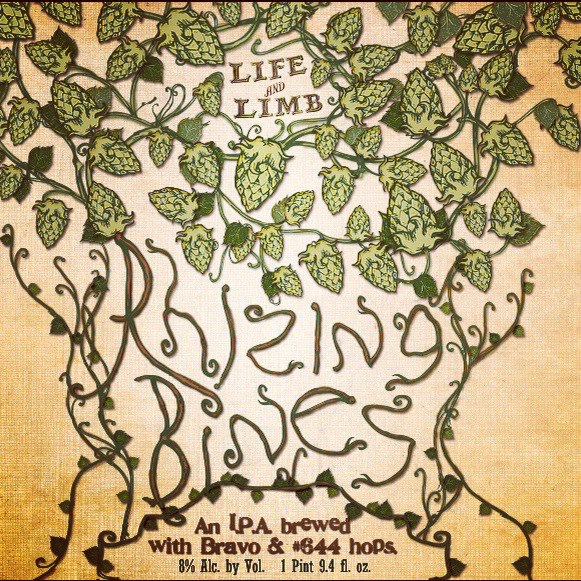
There has been a groundswell of discussion regarding the new Dogfish Head/Sierra Nevada collaboration Rhizing Bines, which is billed as an “East-meets-West” IPA, and with the weekend coming where I’ll finally have enough on hand to sample it out to my customers at Arrowine it’s probably time for me to make my case on its behalf. I say this because while many out there have had their preconceptions and expectations disappointed by Rhizing Bines, I feel that most are needlessly tearing down what we’ll look back on as one of the best new beers of 2013.
 When these two big-name craft brewers first got together to develop a beer, the result was something completely new and different. 2009’s Life & Limb hit the market and was immediately hailed as a triumph. While there were of course outliers who didn’t take to the beer along with those who fell in love with it, the general consensus was that Dogfish and Sierra Nevada had succeeded with their dark, malty Ale with its sweet tones and rich palate. These two titans of hoppy Pale Ales and IPAs took a chance by giving eager fans something they would have never expected, and in doing so expanded the palates of beer geeks all over the country. A subsequent 2011 release was again met with raves; the success of the ’09 release caused the ’11 Life & Limb to be in short supply just about everywhere it was distributed.
As news started to leak that Dogfish Head and Sierra Nevada were getting together again to create another new beer, the buzz began on forums and in stores all over the country. When the news came down that this new effort was to be an Imperial IPA, the hopheads rejoiced; words like finally, slam dunk, and no-brainer were bandied about, but this duo of craft brewers weren’t done taking chances.
In the spirit of their joint effort, Rhizing Bines was to be an IPA designed to unify America’s two predominant IPA styles: the super-piney, high acid-centric West Coast and the maltier, slightly fruiter style referred to as East Coast IPA. To that end both breweries contributed their proprietary yeast strains and opted for newer, less commonly-used hop varieties for Rhizing Bines—Bravo and the too-new-for-a-name Hop 644. The process by which Rhizing Bines was brewed was also a melding of the styles of the two breweries; the Bravo hops were added using the continuous hopping technique that made Dogfish Head famous in its 60, 90, and 120 Minute IPAs, while Hop 644 was used in one of Sierra Nevada’s torpedo devices which made a pit stop in Delaware on its way to Sierra’s new North Carolina brewery.
When the first bottles of Rhizing Bines hit shelves in Virginia a few weeks ago, I took one home to try it out. Upon my first sip I was certain of two things; the first being that I instantly loved the beer. The second thing I knew was that a good two-thirds of the IPA drinkers out there were going to take issue with Rhizing Bines as it was neither overtly piney/acidic enough nor punchy/fruity enough to satisfy hopheads who identify as fans of one ‘coastal’ style over the other. Sure enough, by that weekend I’d already had conversations with customers and folks online who found one reason or another to be disappointed by it. Most of the folks who didn’t enjoy it fell along the lines I’d expected; Rhizing Bines wasn’t “East Coast” or “West Coast” enough for them, despite being a beer that tells you it intends to be neither right on the label.
If nothing else, I hope one of the things to come out of the release of Rhizing Bines is the beginning of the end of the idea that such styles even exist anymore. Once upon a time, there were IPAs whose styles came to be synonymous with one coast or the other as few were widely distributed and generalizations spread. These days there are enough beers distributed all over the country to know that there are brewers everywhere producing all manners of IPA, not to mention brewers on either coast paying homage to brewers on the other.
“West Coast” and “East Coast” can still be used as shorthand for sure, but I usually prefer to characterize IPAs as either “piney” and “sharp”, or “fruity” and “rich” instead. This tends to lead to more critical thinking when describing an IPA, not to mention it doesn’t diminish the relevance of the many, many great IPAs that manage to be more nuanced and do more than one thing well. Rhizing Bines isn’t for everyone, but it’s an extremely well-made IPA that presents an entirely new idea of what it can mean for something to be “hoppy”. This is what makes it a great beer, but it’s also the reason many have a gripe with it.
1,000 words on a local website won’t make lazy reviewers any more thoughtful or make any hopheads more willing to stop self-identifying by anachronistic, narrow-minded terms, but since I have the forum I figured I should use it. For what it’s worth, here are some of my thoughts on Rhizing Bines:
The aroma is less intense than I had expected, but there are some floral hints and a bit of pine. The bottle I had at home was very active with its carbonation; I’ve seen more than one review mention that their bottles had poured almost flat but that certainly wasn’t the case for mine. The initial flavors are of the malts, surprisingly; rather than the typical caramel or coffee, I noticed something more akin to a slightly sweet, almost hazelnutty note. Having read up some more on Rhizing Bines, it turns out some Carolina heirloom red wheat was used in the malt bill, which Dogfish claims adds “subtle sweet and nutty notes”; I’d be curious to find out just how much was used, as it does come through.
The hops take over on the mid-palate through the finish, but in a way I never would have expected: rather than combining the cartoonish high-acid resin notes and cloying grapefruit richness common to the Imperial IPAs on the market, Rhizing Bines carries a more restrained yet no less intense hop flavor of grass and earth that will be familiar if you’re a green tea drinker who has ever steeped a bag (or two) for too long. From there the hops contribute a clarity and dryness that allows the unexpected flavors of Rhizing Bines to stay in focus, and finish with a fading acidic note. It’s very hard to do something new with IPA anymore, and even harder to do something new and good. This is outstanding.
Until next time.
Cheers!
Nick Anderson maintains a blog at www.beermonger.net, and can be found on Twitter at @The_Beermonger. Sign up for Arrowine’s money saving email offers and free wine and beer tastings at www.arrowine.com/mailing-list-signup.aspx. The views and opinions expressed in the column are those of the author and do not necessarily reflect the views of ARLnow.com.
Community discussion guidelines: Our sponsored columns are written by members of the local business community. While we encourage a robust and open discussion, we ask that all reviews of the businesses — good or bad — be directed to another venue, like Yelp. The comments section is intended for a conversation about the topic of the article.
