
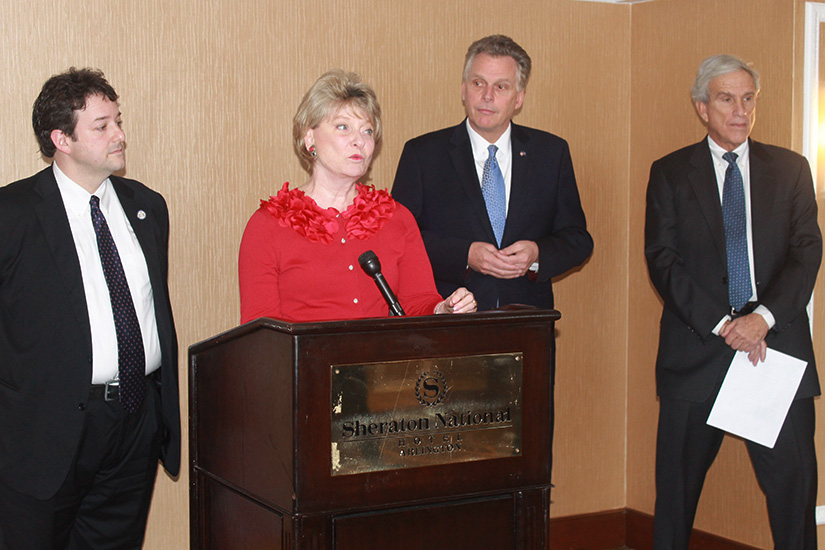
 Democratic Northern Virginia legislators joined gubernatorial hopeful Terry McAuliffe in spending part of the afternoon praising the state’s newly passed transportation bill and Republican Governor Bob McDonnell’s role in pushing it through.
State Sen. Dick Saslaw, Sen. Janet Howell and Del. Alfonso Lopez joined McAuliffe in discussing the bipartisanship and compromises needed for passing the legislation. Howell noted that nobody fully backed the bill but legislators had to put aside their difference to reach a compromise on the state’s first transportation funding plan in nearly three decades.
“We had very different views on what the ultimate solution should be. We had philosophical differences, we had regional differences, we had partisan differences. But we agreed on one crucial matter — doing nothing was no longer an option,” said Howell. “We’ve all disagreed with Governor McDonnell on certain issues, but this was a time when we came together. Like every compromise, no one got exactly what he or she wanted. In fact, there are parts of it that make me want to gag. But we made progress for Virginia.”
The press conference took place near the Washington Blvd bridge over Columbia Pike; speakers took turns referencing the bridge and how the new bill would fund similar infrastructure projects.
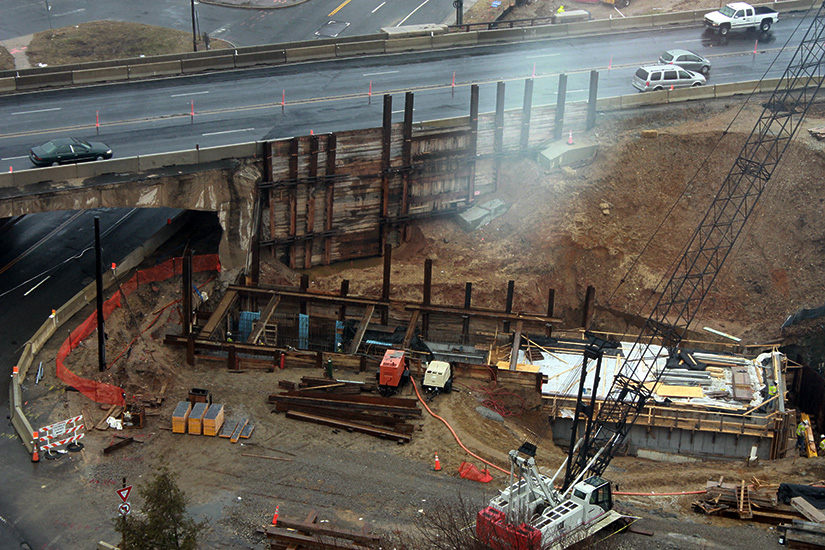 “We have needed this in South Arlington for literally decades. Because of the compromise that we were able to hash out in the General Assembly, there will be projects like this happening all across the Commonwealth,” Lopez said. “Literally, there have been pieces falling out of that bridge for decades and now we’re getting it fixed.”
Although he wasn’t directly a part of passing the legislation himself, McAuliffe said he spent hours on the phone with members of both parties, pushing them to find a compromise. The former Democratic National Committee chairman commended all legislators involved while alluding to more projects on failing infrastructure should he win the governor’s seat.
“We finally have some money to do what we need to do to keep the citizens safe,” said McAuliffe. “This was a bipartisan effort to deal with transportation. We are able to stand here today, where inaction has been happening for 27 years, and say something was done.”
McAuliffe did take time to blast Virginia Attorney General Ken Cuccinelli, who is expected to be his Republican rival for governor. He bashed Cuccinelli, as did the other officials in attendance, for acting as a roadblock to the transportation bill. He then turned his focus to another of his campaign issues — job creation.
“We need to be making sure that if we’re going to get cuts here, your next governor is focused on diversifying this economy, bringing in 21st century jobs. And you can only do that by a great transportation system, a great education system, workforce training,” said McAuliffe. “I can work with anybody, any time of the day, 24 hours a day, 7 days a week, anybody, anytime if you’re going to help me create jobs for the Commonwealth of Virginia.”
One of the issues in the transportation bill that has been controversial in Northern Virginia is the $100 annual tax for hybrid vehicle owners. Saslaw told ARLnow.com that he could potentially argue for either side of that issue, but it might be better for the governor in the long run if he performs a line item veto on that particular measure.
“The governor probably would be better off lining it out. You could say the squeeze ain’t worth the juice having it in there. It’s an awful lot of aggravation for $18 million out of an $800 million dollar thing,” Saslaw said. “It only takes a minute to look at it, I don’t know if he’ll do anything. And if he starts mucking with it too much, it’s going to start to get rejected.”
Saslaw said the issue will likely create more trouble than it’s worth because the number of hybrid drivers in the state is so small — only a little more than 1 percent of the total vehicle owners. He believes it might have made more sense to find another revenue boost, such as raising vehicle registration fees or imposing a tax based on a vehicle’s gas usage per gallon, not simply the fact that it’s hybrid. In the end, he reiterated that the bill was imperfect, but it needed to pass.
“I voted for the compromise, as did everyone else, because when that thing comes out of conference you either vote for it or you don’t vote for it,” said Saslaw. “As Senator Howell pointed out, [it] is not the ideal situation. In fact, when it becomes law, it’s going to have to be tweaked.”
