
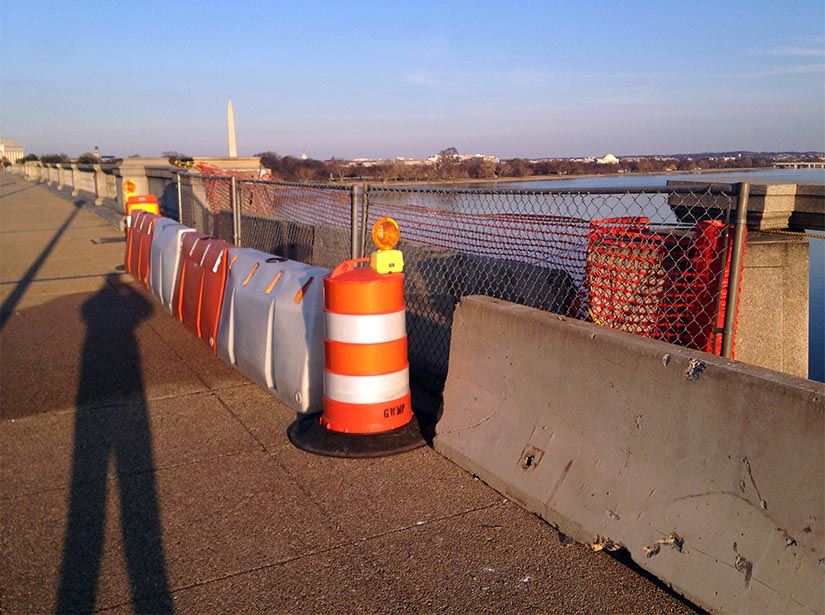
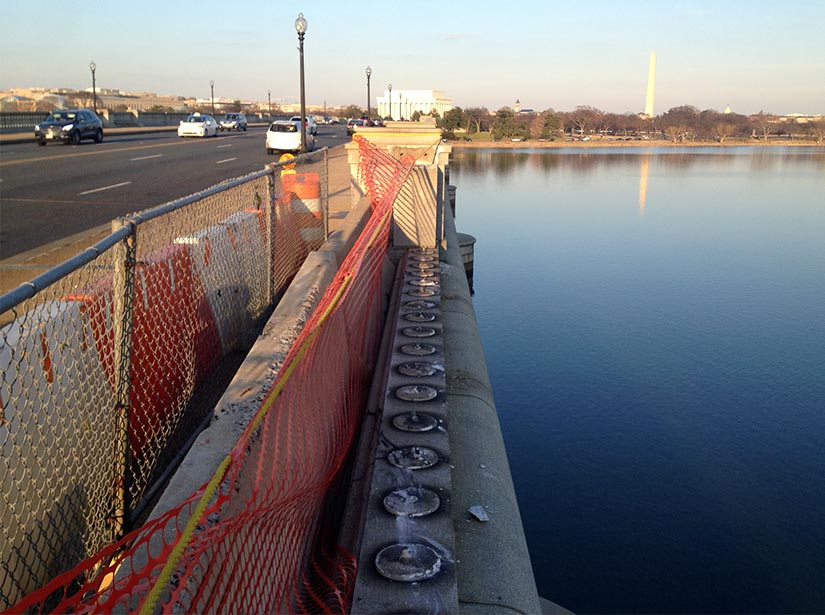
Last night, around 10:00 p.m., an SUV somehow crashed through a barrier on the south side of the Memorial Bridge and landed in the Potomac River.
The driver, the SUV’s lone occupant, escaped the watery wreck and was transported to a local hospital with non-life-threatening injuries. Charges are now pending against the driver, according to U.S. Park Police spokesman Sgt. Paul Brooks.
If you’ve ever feared making a wrong turn and driving off the side of a bridge, AAA Mid-Atlantic has some potentially helpful tips for you. From a press release:
Although they are considered worst-case scenarios, such crashes rarely happen, safety officials and experts say. But that’s of little consolation to local drivers when their vehicle suddenly goes deep six or becomes a leaking boat. What you do and how you react within moments of the crash into the abyss will determine whether you live or die in a watery grave, the auto club advises. “Add darkness and near freezing water, and your chances of escape have greatly diminished,” safety experts warns.
“Although less than one-half of one percent of all automobile crashes involves a vehicle being submerged under water, it is still a very frightening situation to motorists and their terrified passengers, especially young children and the elderly,” said John B. Townsend II, AAA Mid-Atlantic’s Manager of Public and Government Affairs. “Previous research shows that between 400 to 600 persons lose their lives each year in the United States, as their vehicles plummet into a canal, river, or a ditch for that matter.”
Annually, almost ten percent of all drowning deaths in the United States can be attributed to being submerged in a car. If children are in the car, the driver or the adult should focus on getting the children out safely first and keeping them from panicking during the petrifying ordeal. In most crashes of this nature, the heaviest end of the deep-sixed vehicle – usually the end with the engine – will begin sinking first, pulling the car down at an angle, notes Popular Mechanic. That is, unless the water is 15 feet or deeper. In that case, the vehicle may land on its roof, compounding the dangers and risks for the occupants.
Although most vehicles will float for three or four minutes before they start sinking due to the surprising buoyancy of the vehicle in deep water and depending upon on the airtightness of the vehicles, time is still of the essence, advises AAA Mid-Atlantic. The overarching concern is getting to dry land as quickly as possible. Your safety and the lives of your passengers depend upon that.
So, the first key to surviving such a mishap is remaining calm, according to safety experts. Underscoring this, the National Safety Commission puts it this way: “The first and most important thing to remember, if your vehicle is submerged, is to remain CALM – easier said than done-but it’s the most important thing you can do to stay alive.” However, the experts tend to vary on their tips. For example, the brothers Magliozzi, Tom and Ray, of NPR’s “Car Talk” say: “The correct way to get out of a sinking car is to float in the cabin until water is within about 2 inches of the roof. At that time pressure in and outside the car will be equal and it will be easy to open the door and swim out.”
For safety’s sake and to avoid confusion, first responders and the National Safety Commission offer the following tips when your vehicle plunges into the fathoms below:
- Don’t panic. Once your car hits the water it will not sink immediately (You will have at least one or two minutes before the car begins to sink, safety experts say).
- If possible, jump out while car is on surface.
- If your car is still floating, roll down the window and unbuckle your seat belt to escape.
- If your car is submerged, safety experts suggest remaining buckled up while you break the driver or passenger’s side window to escape.
- Allow the pressure of the water to equalize inside the sodden vehicle before attempting to open the doors or windows. Water weighs 62.4 lbs. per cubic foot.
- Move toward rear of vehicle where the air bubble is forming.
- Water pressure against the water-logged doors will make opening the doors very difficult until the pressure inside of the vehicle and outside of the vehicle are equal.
- Open your windows to allow yourself and your passengers to escape (Contrary to popular opinion, the “power windows won’t stop working within seconds after impact.” The power can stay on as along as 10 minutes).
The nightmarish crash from the Memorial Bridge is a reminder to motorists of the importance of carrying and keeping a sharp tool, such as a Philips screwdriver or a spring-loaded center punch, in their glove compartment or in the cabin of their vehicle. The tool is a life-saver. Here’s why: it allows you to break the tempered glass to extricate yourself and your passengers from the sinking vehicle. Other salient tips include:
- If the windows are blocked, try to push the windshield or rear window out with your feet or shoulder.
- Rescue the children or passengers who need assistance to help them to escape. If children are in the sinking or submerged car, unbuckle their seatbelts and or child passenger seat, starting with the oldest child first.
- Safeguard the kids. Push the children out of the vehicle ahead of you.
- Always keep a window-breaking tool in your vehicle in an easily accessible location, safety experts suggest.
- Remove heavy clothing before attempting to swim to safety.
- Swim to the surface as safely and quickly as possible (swim in the direction of the current if you’re in deep water).
- Push off for quick rise to the surface.
- If you can’t swim try to float. Use your body’s natural buoyancy to float. Make sure to raise your head to breathe.
- Call for medical attention as quickly as possible.
Ironically, just last week crews from the Federal Highway Administration reportedly began an “extensive inspection of the deck of the iconic 80-year-old Arlington Memorial Bridge, a process that is expected to continue through March 5. In September the 2,163 feet long bridge underwent a two month long renovation, costing $788,375, to repair and replace its entire driving surface.
Photos courtesy Mark P.
