
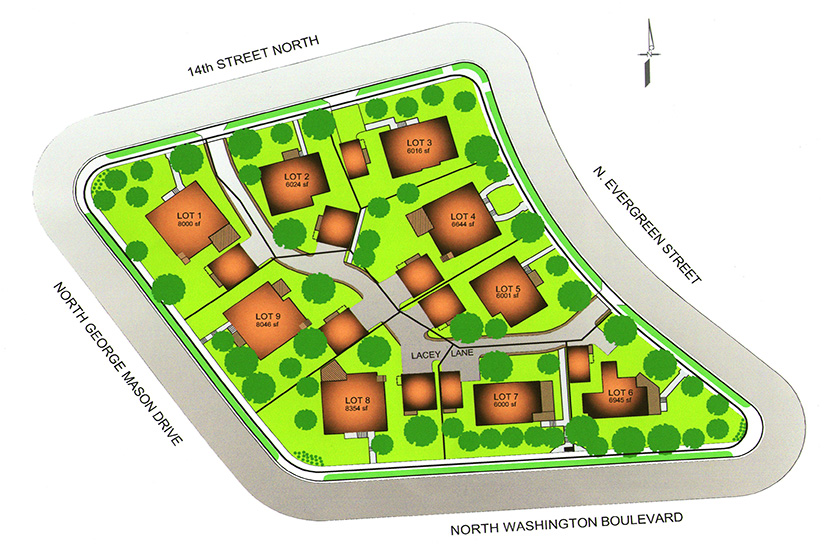
Preview of New Lacey Lane Subdivision

Lacey Lane subdivision plan

The developer behind the upcoming Lacey Lane subdivision in the Waycroft-Woodlawn neighborhood is giving peek at what the new area will look like once it’s developed.

The Barrett Companies, which is a business run by the Chamberlin family since the 1980s, bought the vacant property on the corner of Washington Blvd and N. George Mason Drive and had it excavated last month. The Chamberlins had been working to acquire the land for about a decade.

According to brothers Taylor and Milton Chamberlin, the goal for the Georgian style homes is for them to be an alternative to “McMansions.”

“We really take our time to design the homes to fit in the neighborhood. We’re not builders that come in and put this huge McMansion in a small neighborhood where it doesn’t fit. That’s not what we do,” said Taylor. “All of this is really thought through and it’s really livable, usable space. It’s not those McMansions where you walk in and wonder, ‘What do you do in this room?’”

The base model runs around $1.4 million and features four bedrooms and 4.5 bathrooms, with the possibility of another bedroom and bathroom on an additional level. Costs will vary based on the different lot sizes and individual add-ons the purchasers want in their homes.

“We’re pretty enthusiastic about what we’re giving back to the community and what we’re providing for people who want to live there,” Taylor said. “They’re neat homes, they’re going to be well built.”

Another goal is to foster a 1950s sense of community in which everybody knows and interacts with their neighbors. The homes will only be accessible via a private road and there will be a small fence around the subdivision.

“There’s a sense of community where people can interact a little bit more, but not lose their privacy,” said Milton.

The homes feature outdoor living area options — such as screened in “sleeping porches” off the second floor bedrooms or fireplaces exposed to the outdoors — which are supposed to add to the sense of community.

“While one neighbor is out grilling, you can see a couple of other neighbors hanging out on their patios,” Milton said. “You can sit and hang out and watch the kids in the backyard. It’s a very functional space.”

The brothers noted The Barrett Companies’ effort toward green building and energy efficiency. From better insulation and caulking to installing appropriate outlets in the detached garages for plugging in an electric car, the Chamberlins believe small touches make their properties stand out.

“It’s the little things that are very time consuming that a lot of builders wouldn’t want to do,” Taylor said. “All those little things add up. It makes it so much more efficient.”
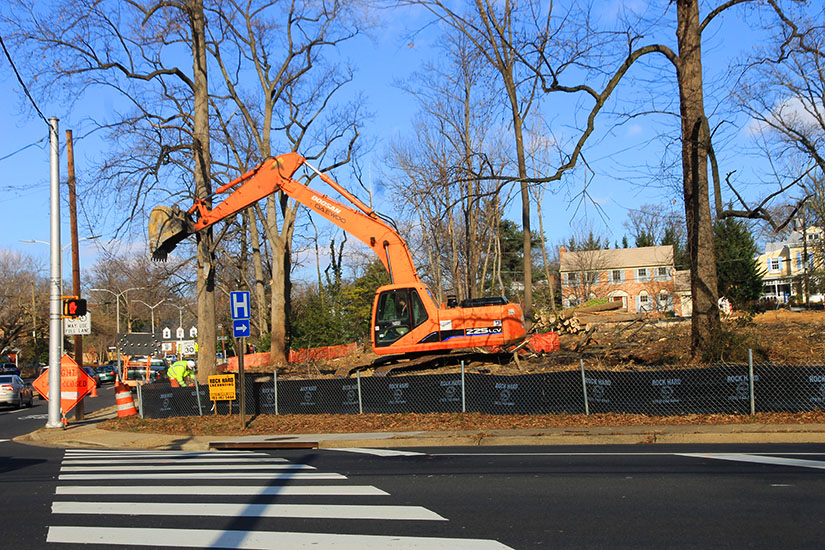
Excavation at Washington Blvd and N. George Mason DriveA few neighbors had voiced concerns about last month’s removal of around 150 trees on the property to make way for the subdivision. But Taylor said the trees that were removed weren’t of high quality; many of them will be replaced with new trees that are native to Virginia.

“The trees that were on this site were very low quality trees per Arlington County’s grading scale. A lot had just grown wild over the years,” said Taylor. “In the process of coming back in here, we’re putting in a lot of newer, higher quality trees to grow up around the homes. I do understand the concern of neighbors around it. They’re going to see that it will be beautiful and lush and green again.”

Arlington County Urban Forester Vincent Verweij confirmed that developers must preserve or re-plant about 20 percent of the trees that stood on an excavated property according to the Chesapeake Bay Preservation Ordinance. If such guidelines are not met, the county will not grant final occupancy permits.

“Arlington does a great job of protecting the county from a landscape perspective,” Milton said.

Model homes will be built on lots four and five, and the other seven homes will be built as customers purchase them. Work should begin on the first model in the next 30 days or so, with work on the second model beginning shortly thereafter. The homes are expected to take about seven months to build, so the models should be ready by autumn. The Chamberlins hope the whole project will be completed in about a year to a year and a half.

Don’t Settle for Student Loans to Pay for Online Education

Online college programs are becoming a more popular choice for prospective students, with one study finding that more than 6 million students enrolled in at least one online course in fall 2015. The popularity of these courses can be attributed in part to their flexibility with working adults' schedules, students' ability to progress more quickly through online programs and, oftentimes, cheaper tuition. [See 10 low-cost online bachelor's programs for out-of-state students.]Online degrees can be beneficial to many college students, but some studies have shown online learners complete their programs at lower rates than students at traditional brick-and-mortar campuses. Individuals with student loans but no degree comprise two-thirds of defaulted borrowers. Though these numbers are not encouraging, just like for traditional programs, there are ways to reduce how much you'll need to borrow for an online program to ensure you won't become one of these statistics. Don't just settle on borrowing student loans to cover the whole cost of your program and living expenses. Instead, start thinking about how to cut costs and cover your balance in different ways, such as the following. -- Grants and scholarships: Even though you are taking an online course, you can still apply and receive grants and scholarships. But your first step should be to complete the Free Application for Federal Student Aid, commonly referred to as the FAFSA, which will allow you to receive a Pell Grant if your expected family contribution is low enough. The EFC criteria and award amounts are adjusted annually, but the 2017-2018 academic year awards range from $606 to $5,920, which could significantly lower the amount you borrow annually. Your next step is to apply for scholarships. You can start by checking online scholarship search engines, such as the Salt Scholarship Search, College Board's BigFuture and Peterson's. But don't forget to take advantage of local organizations and your school's financial aid office. Both may offer scholarships that you can't find with a national scholarship search. [Review these 10 sites to kick off your scholarship search.]For instance, organizations like the Elks Club, Knights of Columbus or the Rotary Club typically offer scholarships annually to local students. Just because you're going to school online doesn't mean you're ineligible. Visit your local library for scholarship listings, and ask around town. You might be surprised how many local organizations offer scholarships. While these scholarships typically aren't large, every little bit counts. Each dollar you receive in a scholarship is a dollar you don't have to borrow and pay interest on. -- Work-study: Another option for online students may be work-study awards. Not all students enrolled in online programs are eligible, but students at some schools -- including, for example, SUNY Empire State College and Liberty University -- are. Work-study awards are not given upfront like scholarships and grants. In most cases, they are an offer to earn up to the awarded amount if you secure an eligible work-study job. While there is a misconception that all work-study jobs must be on campus, students can work for off-campus, nonprofit or public employers as long as the work is in the public's interest. You may be able to work for a for-profit employer if the job is relevant to your course of study. No matter who the outside employer is, it will need to have an established agreement with your college for you to receive work-study funds. Remember, to be eligible for federal financial aid, you must be enrolled and pursuing a degree or certificate. If you're not working toward a credential, Pell Grants and work-study won't be option, but you may still be able to take advantage of private scholarships -- just be sure to read the eligibility criteria carefully. [Explore what to know about financial aid in online programs.]-- Pay as you go: One of the great benefits to enrolling online is the flexible schedule, which can allow you to complete your college coursework around your responsibilities. But prospective students often overlook using their part- or full-time job earnings as an option for paying for college. Almost 80 percent of college students in 2015 worked at least part time while attending classes, according to the National Center for Education Statistics. By budgeting and thinking strategically about your college costs, you can likely reduce your dependence on student loans by paying a portion out of pocket. Many -- but not all -- online programs are less expensive than traditional programs and often have shorter payment periods. Six, eight or 10 weeks are common course durations. Because of the frequency of payments in an online setting, you may be well-placed to pay as you go and possibly avoid borrowing altogether. Attending college online and avoiding student loans may be challenging, but if you are willing to put in the effort, you can limit the amount you need to borrow. More from U.S. News Q&A: Understanding Student Loan Discharge Eligibility Student Loan Refinancing Isn't Right for All Borrowers
Read Next Story