
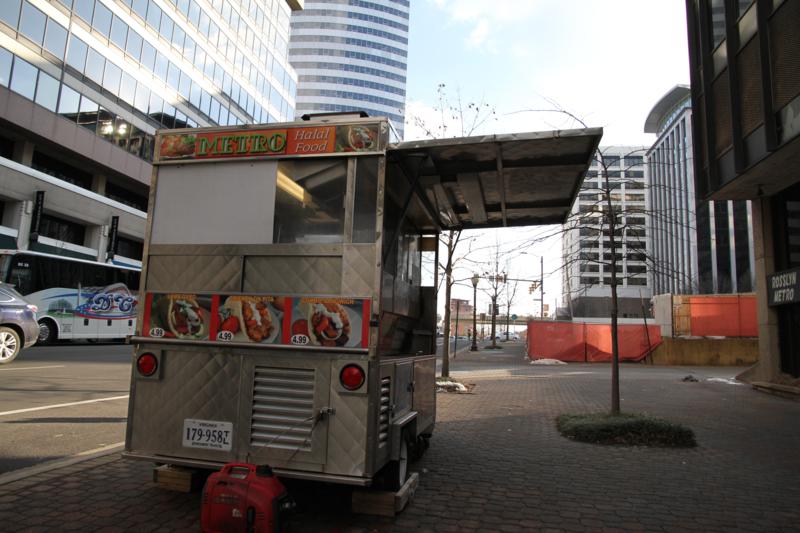
Rosslyn BID Statement on Food Truck Regulations

The Rosslyn Business Improvement District has issued a press release regarding its support for additional mobile food vendor regulations in Arlington County.

Citing “challenges” posed by the 100 or so food trucks and carts licensed in Arlington, the BID says the county should work to create a “level playing field” between mobile vendors and restaurants. Among the BID’s recommendations are regulating the “location and schedule of food trucks, trash, parking and access to restroom facilities.”

We reported exclusively last week that the BID was in the process of formulating a set of recommended county regulations for food trucks, at least in part to protect brick-and-mortar restaurants against the onslaught of competition from food trucks, which don’t make the same kind of long-term investments in a neighborhood as restaurant owners.

The full press release is below.

The Rosslyn Business Improvement District is collaborating with Arlington County and other County-based BIDs to explore different ways of actively managing mobile food vendors within the community.

Business Improvement Districts across the nation and within the greater Washington, D.C. metropolitan area are working with municipalities, business communities and other stakeholders to create vibrant hospitality zones and sociable cities, and restaurants and food trucks are part of that mix.

“Our review of this issue is a work in progress,” says BID Executive Director Cecilia Cassidy. “The goal is a level playing field, an enriched streetscape and a variety of dining experiences, while enabling brick-and-mortar food purveyors as well as food trucks to thrive.”

Over the past few years, the number of food vendors has significantly increased in Arlington, with 100 food trucks currently licensed to do business in Rosslyn, Crystal City, Ballston and other areas throughout Arlington County. Georgetown and other D.C. neighborhoods also have seen dramatic increases.

Food trucks enliven the streets and offer dining options to residents, workers and visitors, and as such can be welcome contributors to communities.

Challenges

Food trucks, however, present certain challenges.

  • Trash left behind by food truck vendors that property owners must pay to have removed
  • Pedestrian walkways blocked by food truck lines, creating safety issues
  • Limited parking spaces absorbed by food trucks, preventing customers from reaching brick and mortar businesses
  • Restrooms within property owners’ buildings being used by food truck vendors and customers
  • Health, hygiene and safety concerns

“AED [Arlington Economic Development] staff has started discussions about our retail policies with Arlington’s BIDs and Partnerships, property owners and small businesses, and mobile food vendors,” said Arlington Economic Development’s Director, Terry Holzheimer. “We recognize that any change to the rules and regulations must do three things: accommodate the needs of the mobile food vendors; address the concerns of property owners and businesses; and provide clarity for staff involved in enforcement.”

The BID is coordinating a set of recommendations with other Arlington County BIDs that will be presented to the County within the coming weeks. Based on benchmarking of best practices with other cities across the country, issues covered in the recommendations include location and schedule of food trucks, trash, parking and access to restroom facilities.

For the past 10 years, the Rosslyn BID has worked with Arlington County, local businesses and property owners to revitalize the area and create opportunities for growth. By working collaboratively with Arlington County, the BID seeks to tackle the challenges raised by property owners and tenants by devising a strategic retail plan for Rosslyn.

The Rosslyn BID has established a Retail Task Force to devise strategies to promote strong restaurant and retail development within Rosslyn, recognizing the contribution that food trucks make to the street and dining scene. The Retail Task Force has developed marketing collateral to promote Rosslyn and attract new restaurants and other retailers to the area. Chaired by Wright Sigmund of Vornado/Charles E. Smith, the Retail Task Force is comprised of community members, retailers and property owners.

“New retail opportunities are on the horizon,” says Wright Sigmund. “We have 60,000 square feet of available retail space in Rosslyn, and 44,500 square feet of retail space will be available with the completion of Central Place and 1812 N. Moore Street office towers.”

“We are optimistic that the Rosslyn community can have multiple exciting choices: both food trucks and restaurants,” says Wright Sigmund. “This issue is not unique to Rosslyn, and we welcome continued dialogue on the topic to make it a win-win for all.”


Don’t Settle for Student Loans to Pay for Online Education

Online college programs are becoming a more popular choice for prospective students, with one study finding that more than 6 million students enrolled in at least one online course in fall 2015. The popularity of these courses can be attributed in part to their flexibility with working adults' schedules, students' ability to progress more quickly through online programs and, oftentimes, cheaper tuition. [See 10 low-cost online bachelor's programs for out-of-state students.]Online degrees can be beneficial to many college students, but some studies have shown online learners complete their programs at lower rates than students at traditional brick-and-mortar campuses. Individuals with student loans but no degree comprise two-thirds of defaulted borrowers. Though these numbers are not encouraging, just like for traditional programs, there are ways to reduce how much you'll need to borrow for an online program to ensure you won't become one of these statistics. Don't just settle on borrowing student loans to cover the whole cost of your program and living expenses. Instead, start thinking about how to cut costs and cover your balance in different ways, such as the following. -- Grants and scholarships: Even though you are taking an online course, you can still apply and receive grants and scholarships. But your first step should be to complete the Free Application for Federal Student Aid, commonly referred to as the FAFSA, which will allow you to receive a Pell Grant if your expected family contribution is low enough. The EFC criteria and award amounts are adjusted annually, but the 2017-2018 academic year awards range from $606 to $5,920, which could significantly lower the amount you borrow annually. Your next step is to apply for scholarships. You can start by checking online scholarship search engines, such as the Salt Scholarship Search, College Board's BigFuture and Peterson's. But don't forget to take advantage of local organizations and your school's financial aid office. Both may offer scholarships that you can't find with a national scholarship search. [Review these 10 sites to kick off your scholarship search.]For instance, organizations like the Elks Club, Knights of Columbus or the Rotary Club typically offer scholarships annually to local students. Just because you're going to school online doesn't mean you're ineligible. Visit your local library for scholarship listings, and ask around town. You might be surprised how many local organizations offer scholarships. While these scholarships typically aren't large, every little bit counts. Each dollar you receive in a scholarship is a dollar you don't have to borrow and pay interest on. -- Work-study: Another option for online students may be work-study awards. Not all students enrolled in online programs are eligible, but students at some schools -- including, for example, SUNY Empire State College and Liberty University -- are. Work-study awards are not given upfront like scholarships and grants. In most cases, they are an offer to earn up to the awarded amount if you secure an eligible work-study job. While there is a misconception that all work-study jobs must be on campus, students can work for off-campus, nonprofit or public employers as long as the work is in the public's interest. You may be able to work for a for-profit employer if the job is relevant to your course of study. No matter who the outside employer is, it will need to have an established agreement with your college for you to receive work-study funds. Remember, to be eligible for federal financial aid, you must be enrolled and pursuing a degree or certificate. If you're not working toward a credential, Pell Grants and work-study won't be option, but you may still be able to take advantage of private scholarships -- just be sure to read the eligibility criteria carefully. [Explore what to know about financial aid in online programs.]-- Pay as you go: One of the great benefits to enrolling online is the flexible schedule, which can allow you to complete your college coursework around your responsibilities. But prospective students often overlook using their part- or full-time job earnings as an option for paying for college. Almost 80 percent of college students in 2015 worked at least part time while attending classes, according to the National Center for Education Statistics. By budgeting and thinking strategically about your college costs, you can likely reduce your dependence on student loans by paying a portion out of pocket. Many -- but not all -- online programs are less expensive than traditional programs and often have shorter payment periods. Six, eight or 10 weeks are common course durations. Because of the frequency of payments in an online setting, you may be well-placed to pay as you go and possibly avoid borrowing altogether. Attending college online and avoiding student loans may be challenging, but if you are willing to put in the effort, you can limit the amount you need to borrow. More from U.S. News Q&A: Understanding Student Loan Discharge Eligibility Student Loan Refinancing Isn't Right for All Borrowers
Read Next Story