
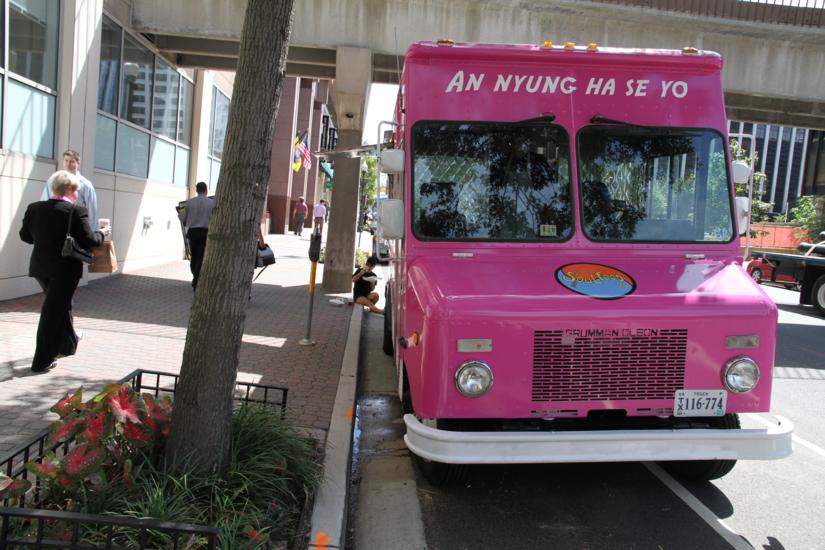
 It’s a debate that’s happening in the District and across the country — how can free-wheeling food trucks peacefully co-exist with brick-and-mortar restaurants? That debate is now coming to Arlington.
The Rosslyn Business Improvement District (BID) is in the process of forming a set of recommendations for the Arlington County Board regarding the regulation of food trucks, according to an internal document obtained by ARLnow.com. The BID, which is funded by the property owners who rent space to the neighborhood’s 59 restaurants, delis and cafes, says in the document that “the number, location and type of operation” of food trucks and carts is “inadequately regulated by Arlington County.”
Even during the “off season” winter months, between 3 and 9 food trucks flock to N. Lynn Street alone to serve hungry Rosslyn lunch-goers, according to the BID. But while residents and workers may appreciate the variety and convenience of food trucks, the restaurants that pay rent in Rosslyn have been complaining.
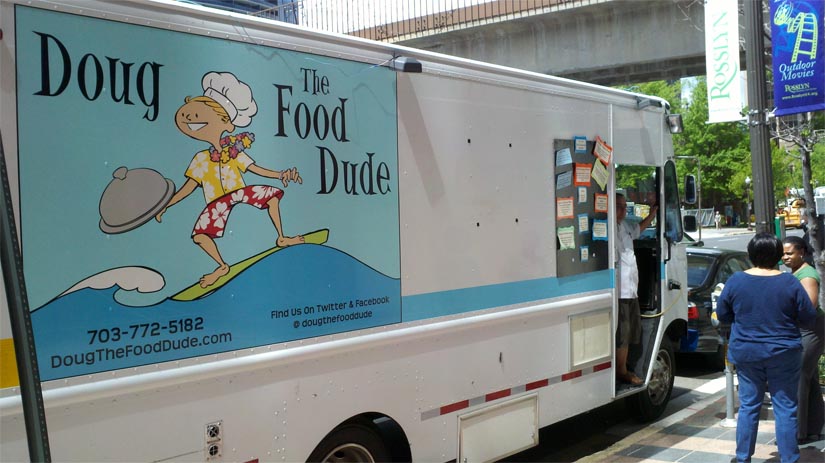 “Food truck operators… park at the busiest and best locations for retail business without paying rent, investing in the community, or ‘playing by the rules,’” the document suggests. “Existing ‘bricks and mortar retail tenants, who have made large investments, are feeling significant impacts [from food trucks]… Revenue is siphoned from retailers.”
“Business owners who have made investments in Arlington County need to be protected,” the document concludes. “The County needs to create a level playing field for both street level retailers and food carts-food trucks.”
To help do so — and to help cure other ills allegedly brought on by food trucks and carts — the Rosslyn BID has formed a number of preliminary recommendations. Some of the recommendations are new, while some are based on existing regulations. Though the document is described as a “work in progress,” the recommendations so far include:
- “Develop a mechanism to address the number and schedule of food trucks during lunch hours. This would provide a consistent approach for both food truck operators and bricks and mortar retailers.”
- “Dedicate a location for food trucks that is not along the main retail areas.”
- “Limit the number of food trucks-food carts per block to no more than two (2) and ensure adequate sidewalk clearance for safe passage of pedestrians.”
- “Restrict the proximity of food trucks to not less than 65 feet away from the front of restaurants.”
- “Require that food truck/food cart employees must have restroom access within 200 feet of the food truck-food cart.”
- “Enhance inspections and impose serious fines for health/safety violations.”
- “Require food trucks/food carts to provide their own trash cans or take away the garbage that they generate.”
- “Ensure County business registration and tax laws continue to be enforced.”
Rosslyn BID Executive Director Cecilia Cassidy says that while food trucks can “enhance the streetscape,” the well-being of retailers must be considered.
 “We feel that the food carts and food trucks need to be actively managed by the county,” Cassidy said. “We want to have varied offerings, but also allow the established restaurant owners to thrive.”
“We’re working with a variety of other partners in Arlington,” Cassidy added — suggesting that Rosslyn isn’t alone in its consideration of food truck issues. She declined to identify the other groups the BID has been collaborating with.
Jill Griffin, commercial development specialist for Arlington Economic Development, says that the county will be having “conversations” with food truck operators and business groups this summer, in an effort to update Arlington’s vending ordinance.
“We’re getting to a point now that having a more holistic look at how food trucks and food carts relate to the general retail of an area is important,” Griffin said. “We see food trucks and food carts… as providing energy and vibrancy on our streets. And we see them as part of our overall street retail. But we recognize also that there’s a tension between property owners [and food trucks]. And we recognize we need to work toward win-win solutions.”
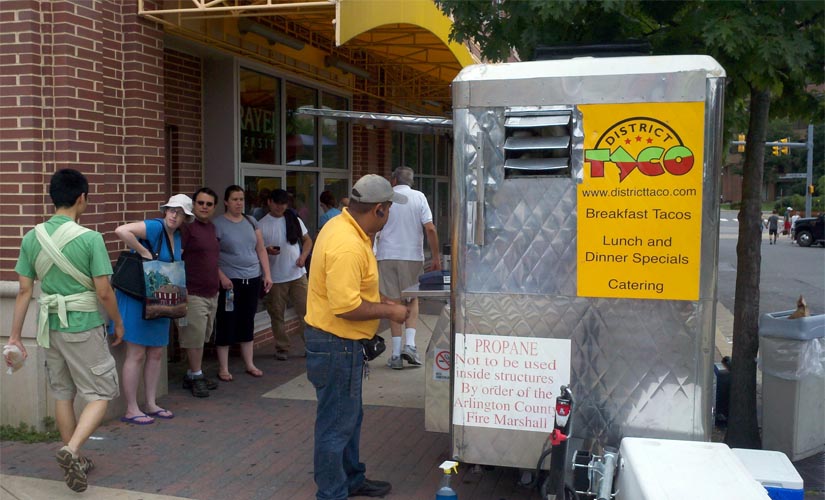
 Food trucks and carts can be an “incubator for some of our small businesses,” Griffin added, citing the cart-to-restaurant success of Pupatella and District Taco. BizLaunch, an initiative of Arlington Economic Development, actually holds seminars for would-be food truck operators.
Griffin said a letter was recently sent from the county’s public health division to the owners of the 97 food trucks and carts currently licensed to operate in Arlington. The letter reminded food truck operators to pick up trash and make sure lines don’t interfere with pedestrian traffic. It also reminded operators that they’re not allowed to park for more than 60 minutes in one spot — a county regulation that Griffin acknowledged is hard to enforce.
“We have heard that enforcement has been challenging,” she said.
After talking with stakeholders this summer, Griffin and AED hope to have recommendations for the County Board by early fall.
In Rosslyn, meanwhile, more restaurant options are likely on the way. There’s currently some 60,000 square feet of retail space for lease in Rosslyn, according to the BID, and another 44,500 square feet that will be available once the Central Place and 1812 N. Moore Street office towers are completed.
“We’re in the middle of a construction push here,” Cassidy said. “We hope in the next 2 to 3 years that we will have a much hardier restaurant community.”
