
Wilson Tavern Now Open in Courthouse

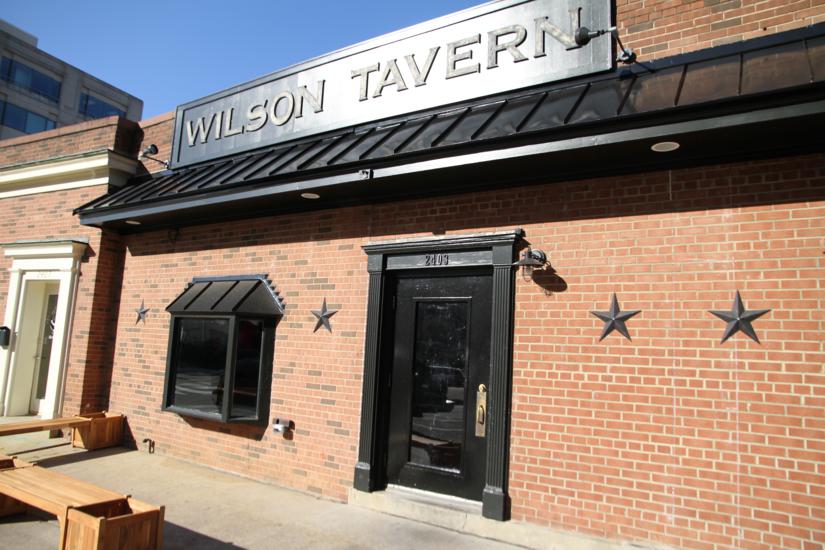
Wilson Tavern (2403 Wilson Blvd) is now open in the old Kitty O’Shea’s space in Courthouse.

The restaurant, which describes its offerings as “updated American classics,” is currently only open for dinner, but plans to start serving lunch on Tuesday. A weekend brunch service is expected to begin later this month, perhaps on Christmas weekend.

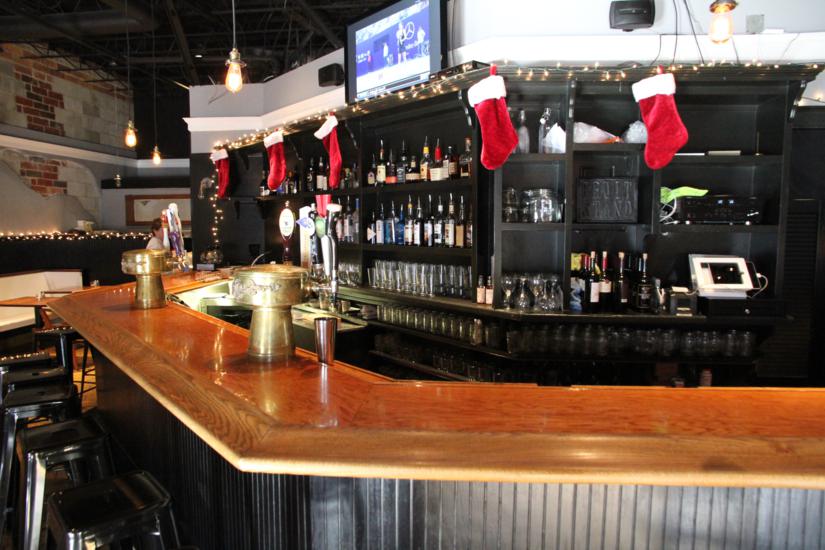
Wilson Tavern retains the small footprint of Kitty O’Shea’s, as well as the prominent bar, but renovations have resulted in an updated look that got rid of the old drop ceiling and exposed some of the building’s rugged brickwork. Black woodwork, an eclectic collection of new and antique furniture including repurposed 19th century church pews, and bare, hanging light bulbs give the tavern a unique, vaguely old-fashioned feel.

The food menu includes updated takes on comfort food, like a burger with beef sourced from The Plains, Va., saffron PEI mussels with steak frites, and stuffed mac ‘n’ cheese with artichoke, pork belly and a brioche crumb. Some may not find the prices as comforting, though: the fish ‘n’ chips is $17 (compared to $13 at Ireland’s Four Courts, down the street), a roasted chicken with collard greens and gravy is $17, and the Plains-sourced burger — with aged cheddar, lettuce, tomato, onion and a brioche bun — is $12.
The menu will be changed seasonally and daily specials will be available. There is also a condensed menu available for late night diners.

The draft beer list, which will also change regularly, currently includes eight curated selections from brewers like New Belgium, Legend, Bell’s and Port City. Drafts range from $5 to $8, while bottled macrobrews like Miller Lite and Budweiser clock in at $4. A short California-centric wine list prices glasses from $6 to $10 and bottles from $22 to $38.

Wilson Tavern will serve classic cocktails made with freshly-squeezed juices. The menu includes a dark and stormy, dazerac, old fashioned, gin and juice, screwdriver, pickled Martini and a Negroni, with prices from $7 to $10.

Wilson Tavern’s chef, Chris Kenworthy, hails from Hook, Equinox and Watershed restaurants in the District. Bar manager Matt Culbertson is a former bartender at PS 7′s in D.C. and Cowboy Cafe in Arlington.

Owner Sandy Lewis, a friend of landlord and fellow Lyon Village resident Ray Schupp, says she hopes Wilson Tavern becomes more of a neighborhood dining destination than Kitty O’Shea’s, which was forced out after a contentious legal battle. Despite a very quiet opening last Tuesday, Lewis says she’s been happy with the number of diners who have been showing up for dinner.

“We’re putting out a little bit higher quality food than the average bar,” she said, pointing to locally-sourced meats, freshly-prepared sauces and other house-made ingredients.

Lewis, a local restaurant veteran, was a former co-owner of CommonWealth Gastropub in D.C. and Hank’s Oyster Bar in Alexandria. She also held management positions at several of Jose Andres-owned eateries. Wilson Tavern, however, is something of a homecoming for her.

“I always wanted to do something in Arlington,” said Lewis. “This is a dream because I can walk to work.”

If all goes well, Lewis says she’s considering expanding Wilson Tavern to an adjacent, empty retail space — a move that would add 20-25 seats to the restaurant. Should Wilson Tavern find success, however, it won’t be long before it’s forced to move. Schupp is seeking county approval to redevelop the single-story retail building in which Wilson Tavern is located into something taller — perhaps a hotel.

Should that happen, Lewis said she would move Wilson Tavern to a nearby, temporary space, then move back into the ground level of the new building.

Wilson Tavern in Courthouse Wilson Tavern in Courthouse Wilson Tavern in Courthouse Wilson Tavern in Courthouse Wilson Tavern in Courthouse Wilson Tavern in Courthouse


Don’t Settle for Student Loans to Pay for Online Education

Online college programs are becoming a more popular choice for prospective students, with one study finding that more than 6 million students enrolled in at least one online course in fall 2015. The popularity of these courses can be attributed in part to their flexibility with working adults' schedules, students' ability to progress more quickly through online programs and, oftentimes, cheaper tuition. [See 10 low-cost online bachelor's programs for out-of-state students.]Online degrees can be beneficial to many college students, but some studies have shown online learners complete their programs at lower rates than students at traditional brick-and-mortar campuses. Individuals with student loans but no degree comprise two-thirds of defaulted borrowers. Though these numbers are not encouraging, just like for traditional programs, there are ways to reduce how much you'll need to borrow for an online program to ensure you won't become one of these statistics. Don't just settle on borrowing student loans to cover the whole cost of your program and living expenses. Instead, start thinking about how to cut costs and cover your balance in different ways, such as the following. -- Grants and scholarships: Even though you are taking an online course, you can still apply and receive grants and scholarships. But your first step should be to complete the Free Application for Federal Student Aid, commonly referred to as the FAFSA, which will allow you to receive a Pell Grant if your expected family contribution is low enough. The EFC criteria and award amounts are adjusted annually, but the 2017-2018 academic year awards range from $606 to $5,920, which could significantly lower the amount you borrow annually. Your next step is to apply for scholarships. You can start by checking online scholarship search engines, such as the Salt Scholarship Search, College Board's BigFuture and Peterson's. But don't forget to take advantage of local organizations and your school's financial aid office. Both may offer scholarships that you can't find with a national scholarship search. [Review these 10 sites to kick off your scholarship search.]For instance, organizations like the Elks Club, Knights of Columbus or the Rotary Club typically offer scholarships annually to local students. Just because you're going to school online doesn't mean you're ineligible. Visit your local library for scholarship listings, and ask around town. You might be surprised how many local organizations offer scholarships. While these scholarships typically aren't large, every little bit counts. Each dollar you receive in a scholarship is a dollar you don't have to borrow and pay interest on. -- Work-study: Another option for online students may be work-study awards. Not all students enrolled in online programs are eligible, but students at some schools -- including, for example, SUNY Empire State College and Liberty University -- are. Work-study awards are not given upfront like scholarships and grants. In most cases, they are an offer to earn up to the awarded amount if you secure an eligible work-study job. While there is a misconception that all work-study jobs must be on campus, students can work for off-campus, nonprofit or public employers as long as the work is in the public's interest. You may be able to work for a for-profit employer if the job is relevant to your course of study. No matter who the outside employer is, it will need to have an established agreement with your college for you to receive work-study funds. Remember, to be eligible for federal financial aid, you must be enrolled and pursuing a degree or certificate. If you're not working toward a credential, Pell Grants and work-study won't be option, but you may still be able to take advantage of private scholarships -- just be sure to read the eligibility criteria carefully. [Explore what to know about financial aid in online programs.]-- Pay as you go: One of the great benefits to enrolling online is the flexible schedule, which can allow you to complete your college coursework around your responsibilities. But prospective students often overlook using their part- or full-time job earnings as an option for paying for college. Almost 80 percent of college students in 2015 worked at least part time while attending classes, according to the National Center for Education Statistics. By budgeting and thinking strategically about your college costs, you can likely reduce your dependence on student loans by paying a portion out of pocket. Many -- but not all -- online programs are less expensive than traditional programs and often have shorter payment periods. Six, eight or 10 weeks are common course durations. Because of the frequency of payments in an online setting, you may be well-placed to pay as you go and possibly avoid borrowing altogether. Attending college online and avoiding student loans may be challenging, but if you are willing to put in the effort, you can limit the amount you need to borrow. More from U.S. News Q&A: Understanding Student Loan Discharge Eligibility Student Loan Refinancing Isn't Right for All Borrowers
Read Next Story