
 A plan to boost the finances of Artisphere, the struggling county-run arts center in Rosslyn, includes dramatic changes to the original vision for the venue.
A revised business plan, which will be presented to the County Board this afternoon, will suggest slashing Artisphere’s hours, shuttering its restaurant and retail store, and generating more revenue via corporate event rentals.
Even if the plan is implemented, however, the task force expects Artisphere to burn through more than $2.3 million in taxpayer funds in financial year 2012 and another $1.6 million in financial year 2013. If the new plan is shelved, Artisphere will require nearly $2.7 million in taxpayer support in FY 2012, the task force said. The one-year-old venue’s original business plan projected only $739,975 in county taxpayer support in FY 2012.
In its report to the Board, the Artisphere Task Force said Artisphere is an attractive venue that benefits from a Metro-accessible location and an experienced management team. But the task force was critical of the lack of focus in the center’s marketing, among other perceived weaknesses.
“Originally billed as an ‘Arts Space for Everyone’, the Artisphere strove to be free from the constraints of a singular vision, performance type or audience,” the task force wrote. “However, the unintended consequence of the individual interpretations that arose from such branding has been confusion over what exactly Artisphere is supposed to be, and for whom.”
The task force also accused Artisphere of practically ignoring families and older adults in its programming.
Artisphere, following the original business plan, has oriented much of its programming to attract a core audience of 20-35 year olds. While Arlington has one of the largest concentrations of 20 to 35 year olds in the nation, and while this demographic — like others who are highly educated, highly paid, and with disposable income — is known for its inclination to patronize the arts, they are faced with multiple options for spending time and money. Given those competing interests, and the somewhat “fickle” nature of this age group, it is very difficult to consistently attract them. Conversely, the 35-45 year olds with families and 55-65 year old empty-nesters, all with heavy populations in Arlington and the Washington, D.C. region have not been a target.
(Current programming at Artisphere includes the “largest collection of hand-crafted harmonica cases in the world” and an interactive exhibit that requires viewers to scan bar codes with their cell phones. The venue named a new programming director in late October.)
In the end, Artisphere has fallen well short of its original attendance projections. As the report noted, the lack of foot traffic is especially pronounced during the day.
“The space has been underutilized for many of its daytime hours,” the task force wrote. “Often, patrons who may enter in the early afternoon hours find the Artisphere extremely quiet and almost deserted. This lack of excitement and vibrancy often discourages return visits.”
To help place Artisphere on a more sustainable path, the task force is recommending several dramatic changes. One of the most pronounced is the proposed change in Artisphere’s hours. Whereas the center is currently open seven days a week, for a total of at least 85 hours per week, the task force wants to slash the days and hours the venue is open to the public. Under the new plan, Artisphere would be closed to the public on Monday and Tuesday, and would only be open for a total of 40 hours Wednesday through Sunday.
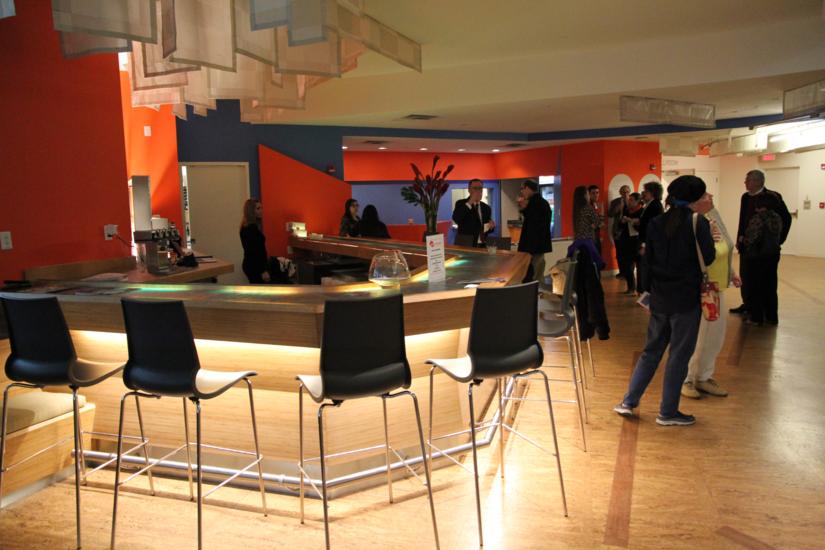 In another significant departure from Artisphere’s original business plan, the task force recommends closing Artisphere’s privately-run restaurant and replacing it only with a “resident caterer” that would serve food only during scheduled performances and certain private events.
HERE CafeBar, a restaurant that operates on Artisphere’s second floor and serves a limited Latin-inspired menu, will close after Wednesday (Nov. 30); the restaurant’s owners decided not to renew their lease after being open for only 8 months. The task force cited several factors that contributed to the HERE’s struggles.
“The restaurant area feels very open; there are no visual cues that one is actually in the restaurant… There exist very few possibilities for signage on the exterior of the Artisphere for the restaurant… A second-floor, non-ground level location with no direct outside access is considered by restaurateurs to be an extremely poor location,” the task force wrote. The restaurant’s impending closure was first reported by the Washington Business Journal.
To generate more revenue for Artisphere, and to offset the lack of revenue from ticket sales (part of the original business plan), the task force recommends ramping up Artisphere’s event rental business.
The new Artisphere business plan includes a heavily marketed and highly active Event Rentals program for daytime and evening corporate and social rentals to help offset some fixed, facility-related costs and programming costs. Given direct experience of the Task Force with event rentals, as well as discussions with other organizations who have rented the Artisphere, there is reasonable and reliable demand for event rentals. In its first year of operations, the Artisphere collected nearly $215,000 in event rental income, with no marketing or other active solicitation of rental clients – and despite a number of challenges. For example, at times the Event Rentals program was severely understaffed and many early mistakes were made, including an inability and unwillingness to book space more than three months in advance; a lack of program policies, infrastructure and technology; and a lack of agreement with the landlord on the types of events for which the Artisphere could be rented.
Artisphere would be made available for private rentals even on days and at times when it’s not open to the public. To support the event rental business, the task force proposes hiring two rental managers and a new Chief Financial Officer.
Other recommended changes include:
- Closing the money-losing Artisan Center of Virginia retail shop on Artisphere’s first floor
- Relying more heavily on Arlington-based art groups to provide Artisphere programming
- Folding Artisphere and its staff into the umbrella of the Arlington Cultural Affairs Division
- Forming a 501(c)3 organization to raise private funds for Artisphere from individuals and organizations reluctant to give money directly to a government entity
The revised business plan is scheduled to be presented at the Board’s 3:00 p.m. meeting this afternoon.
