
 A historic Yorktown High School football season came to an end Friday with a disappointing 37-13 loss to South County in the VHSL Class AAA Division 5 Northern Region championship game.
The Patriots finished the regular season undefeated (10-0) for the first time and reached the championship thanks to a pair of dominating playoff wins over McLean (20-16) and Lee (50-15), but they had no answer for the physical Stallion defense, led by Virginia Tech recruit Devin Vandyke, who had three sacks and a fumble recovery.
Vandyke and Oren Burks collapsed the pocket on what seemed like every play, coming hard up the middle and off the edge, and South County’s defense pressured Yorktown quarterback Smith into two interceptions and a fumble.
The Stallions came into the game with nine consecutive wins, including last week’s playoff victory over perennial region power Stone Bridge.
“Play by play, they outplayed us,” said Yorktown senior quarterback Jordan Smith, who scrambled for just 6 yards on 16 carries due to the pressure from South County. “It wasn’t that we weren’t ready. We just didn’t come to play. I don’t know…”
Smith threw one touchdown pass, but completed just 8-of-20 for 107 yards. The Patriots hadn’t scored fewer than 20 points all season and had scored 40 or more eight times. On Friday, they managed just one offensive touchdown, on a 17-yard pass from Smith to sophomore running back M.J. Stewart that cut the deficit to 37-13 in the fourth quarter.
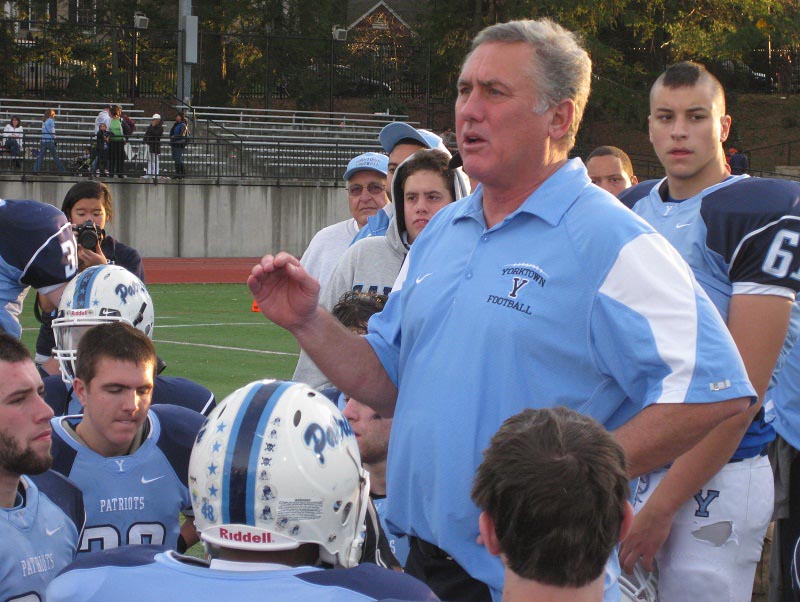 “We just hadn’t seen any athletes like [Vandyke and Burks] all season,” said Yorktown coach Bruce Hanson, who won his 200th career game earlier this year. “They had a great scheme and we didn’t have any kind of field position.”
Vandyke’s fumble recovery led to South County’s first touchdown — which came on a two-yard run from quarterback Shane Foley with three minutes left in the second quarter – and made it 10-0.
The Stallions’ defense has been their hallmark all season, and Friday was no different. Timmy Hunt returned a Smith pass early in the fourth quarter 65 yards to make it 31-7, and the Patriots gave up a blocked punt that was recovered by South County in the end zone with 9:32 to play that made it 37-7.
“Our quarterback just wasn’t used to that type of pressure,” Hanson said.
South County limited Yorktown to just 195 yards of total offense, about half of what the Patriots had generated in each prior game.
“We treated these guys like the best athletes in the region, which they are,” said Vandyke. “We had a really good scout team this week, and we knew what they were going to do.”
Yorktown’s other score came when Stewart returned an interception 40 yards to cut the South County lead to 17-7 early in the third quarter, but the Stallions answered right back with an Andrew Rector touchdown that made it 24-7 just three minutes later.
Stewart, who had perhaps the best offensive season in Yorktown history, with over 1,500 yards rushing and 31 touchdowns, was bottled up by the South County defense, gaining only 35 yards on 17 carries.
“We played great this year, but we didn’t play so great today,” said fullback Austin Browne, who gave South County trouble with 28 yards on five runs up the middle. “I can’t be mad at how we did this year, but we aimed to go a little further than we did.”
South County, which will host Hanover next Saturday in the state semifinals, was clearly the toughest opponent the Patriots had face all season, and both Browne and Hanson said the team had trouble recovering from the early deficit.
“[It was] a lack of preparedness for a tough game,” said Browne. “We’d never been down this year so this was a new feeling for us.”
Hanson said he thought it might have been good for his team to have suffered a loss or played a couple of stronger opponents ahead of Friday’s game.
“You win them all, and you like that,” Hanson said. “But sometimes there’s something to be said for losing a game. We didn’t face a team like Centreville, for example, like we did last year.”
Along with the pressure, Hanson said his team was on the wrong end of the field position battle. The Patriots started nine of their first 11 drives inside their 26.
“We just couldn’t punch it out of there,” he said.
The Patriots reached the regional final for the first time since 2003 and won a playoff game for the first time in five years.
“We’ve had two other teams that have won championships, so I can’t rank these guys higher,” said Hanson. “But as far as most fun to coach, this was the one. We were really clicking.”
Hanson said it will be tough to replace Browne, Smith and Nick White, who helped the Patriots to a 21-3 record over the last two seasons. But the cupboard is not bare.
“We’re certainly not going to be dogmeat, that’s for sure,” Hanson said.
Browne said he’ll be happy to come back to see Yorktown play in 2012.
“They’re going to be strong and come out next year knowing that if we could reach this game this year, their goal is going to be to win it.”
